Copyright Registration for Trademarks in India: TM-C, Process, Fees and Documents
A business may already have a logo or brand identity and still wonder: “If I am applying for a trademark, do I also need copyright registration?” The confusion is common because.
Published 2 August 20267 min readBy Kar Sathi Team
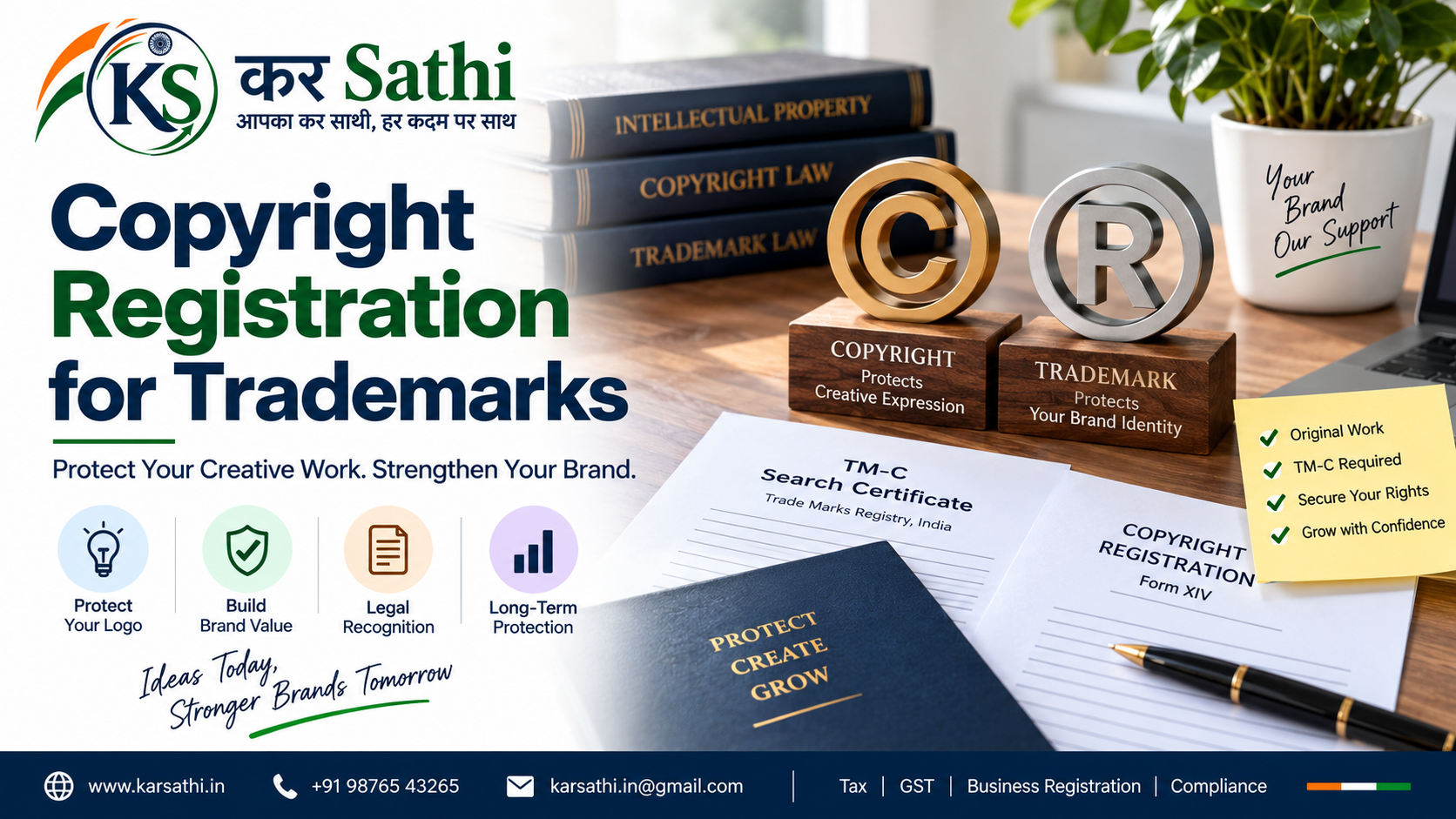
A business may already have a logo or brand identity and still wonder: “If I am applying for a trademark, do I also need copyright registration?” The confusion is common because trademarks and copyright can sometimes protect different aspects of the same brand.
A trademark mainly protects a brand identifier used in business, while copyright protects original creative expression. When an original logo or artistic work is used, or is capable of being used, in connection with goods or services, there is a specific process to consider for copyright registration, including a TM-C search certificate from the Trade Marks Registry. ([IP India][1])
Copyright Registration for Trademark at a Glance
WHY CLIENTS CHOOSE KAR SATHI
✓ Tax Experts✓ Maximum Refund Assistance✓ Notice Support✓ Secure Documents✓ Transparent Pricing✓ Fast Turnaround
Trademark Class Search in India: How to Choose the Right Class Before Filing
Choosing a trademark name is only one part of the registration process. A common problem arises when a business has a good brand name but files the application under the wrong.
Kar Sathi is an independent private platform and is not affiliated with, endorsed by, sponsored by, or authorized by any government entity. Government-related information provided by Kar Sathi is for informational purposes only. Users should verify information with the relevant official government source.
Official government source links
Use these official websites to verify current information:
TM-C Search Certificate for relevant artistic works
Copyright Government Fee
₹2,000 per work for artistic work used/capable of being used with goods or services
TM-C E-filing Fee
₹9,000 per mark
Ordinary TM-C Timeline
Ordinarily within 30 working days
Copyright Objection Period
30 days from receipt of application
Authority
Copyright Office and Trade Marks Registry
The Copyright Office confirms that copyright arises automatically when an eligible original work is created; registration is not mandatory to create copyright. Registration, however, can serve as prima facie evidence regarding the particulars entered in the Register of Copyrights. ([IP India][2])
Copyright and Trademark: What Is the Difference?
Copyright and trademark are separate intellectual-property rights.
A trademark can protect signs that distinguish the goods or services of one business from another, including words, logos, symbols and certain other marks. ([IP India][1])
Copyright, on the other hand, protects original works such as literary, dramatic, musical and artistic works, cinematograph films and sound recordings. ([IP India][2])
For a business logo, there can sometimes be an overlap. The logo may function as a trademark because it identifies the business and may also qualify as an artistic work for copyright purposes.
However, this does not mean every trademark or business name automatically qualifies for copyright registration. The nature and originality of the work matter.
Important Note: Trademark registration and copyright registration are not substitutes for each other. Depending on the asset and business use, a business may consider one or both forms of protection.
Why Is TM-C Required for Certain Copyright Applications?
This is one of the most important points when registering copyright in a business logo.
Where an artistic work is used or is capable of being used in relation to goods or services, the Copyright Office states that the copyright application should be accompanied by a certificate from the Registrar of Trade Marks showing that no identical or deceptively similar trademark has been registered or applied for by another person, as provided under Section 45. ([IP India][2])
The request for this search certificate is made in Form TM-C. Under Rule 22 of the Trade Marks Rules, 2017, the Registrar conducts the relevant search and issues the certificate subject to the applicable requirements. ([IP India][3])
Documents Required
The documents can vary according to ownership and the nature of the work, but commonly relevant documents include:
Copy of the logo or artistic work
Applicant's name, address and nationality details
Details of the author/creator
Form XIV and prescribed statements
TM-C Search Certificate, where applicable
Author's NOC where the copyright owner and author are different, where required
Authorisation/Power of Attorney documents, where applicable
Publication details, if the work has already been published
Supporting ownership or assignment documents, where relevant
Each copyright registration application is for one work only and must be accompanied by the applicable fee. ([Copyright Office of India][4])
Step-by-Step Copyright Registration Process for a Trademark Logo
1. Check the Nature of the Logo
First determine whether the material being protected is an original artistic work.
A plain business name and a professionally designed artistic logo should not automatically be treated the same way.
2. Apply for the TM-C Search Certificate
For an artistic work used or capable of being used with goods or services, request the required search certificate through Form TM-C.
The current official fee schedule lists ₹9,000 for electronic filing of the ordinary TM-C request and ₹10,000 for physical filing. The expedited electronic request is listed at ₹30,000. ([IP India][5])
Under Rule 22, an ordinary certificate is stated to be issued ordinarily within 30 working days, while the expedited route is stated as ordinarily within seven working days, subject to the applicable requirements. ([IP India][3])
3. Prepare Form XIV
Copyright registration is made through Form XIV. The application contains details about the work, applicant, author, ownership and related particulars. ([Copyright Office of India][6])
4. Pay the Copyright Registration Fee
For an artistic work used or capable of being used in relation to goods or services, the Copyright Office currently prescribes a government fee of:
₹2,000 per work. ([Copyright Office of India][7])
Government fees may change, so the latest official schedule should be checked before filing.
5. File the Application and Supporting Documents
The application can be filed using the Copyright Office's prescribed process, including its online filing facility. ([Copyright Office of India][4])
The submitted information should remain consistent across the TM-C certificate, artwork and copyright application.
6. Wait for the Objection Period and Examination
Rule 70 provides a 30-day period from receipt of the copyright application during which objections may be received. If no objection is received and the Registrar is satisfied with the application particulars, the details may be entered in the Register. ([Copyright Office of India][4])
This 30-day period should not be confused with a guaranteed registration timeline. Overall processing can take longer if examination issues or objections arise.
Fees and Timeline
Particular
Current Government Fee / Timeline
TM-C Search – E-filing
₹9,000 per mark
TM-C Search – Physical
₹10,000 per mark
Expedited TM-C – E-filing
₹30,000
Copyright of Relevant Artistic Work
₹2,000 per work
Ordinary TM-C
Ordinarily within 30 working days
Expedited TM-C
Ordinarily within 7 working days
Copyright Objection Window
30 days from receipt of application
These are statutory/government charges and should always be verified against the current official fee schedules before filing. ([IP India][5])
Practical Example
Suppose a company creates a distinctive graphic logo called “Zenvora” and uses it on its products, website and packaging.
The business may consider trademark registration to protect the logo as a source identifier. If the logo also qualifies as original artistic work and the company wishes to register its copyright, the copyright procedure may require a TM-C Search Certificate because the artwork is being used in connection with goods or services.
The two registrations deal with different legal rights even though the same logo may be involved.
Assuming every brand name qualifies for copyright protection
Filing the copyright application without checking whether TM-C applies
Submitting a logo different from the artwork covered by TM-C
Not clarifying ownership between the designer and business
Filing without an author's NOC or assignment document where relevant
Treating the 30-day objection period as a guaranteed registration period
Paying fees under the wrong category
Why Choose Kar Sathi?
Brand protection can involve more than simply filing one application. Kar Sathi can help businesses understand whether their logo should be considered for trademark registration, copyright registration or both.
Support can include reviewing the artwork, assisting with the TM-C request, organising the required documents, preparing the copyright registration application and helping keep the filing information consistent throughout the process.
Readers can also refer to Kar Sathi's Trademark Registration Guide, Trademark Class Search Guide and Trademark Objection Reply Guide for related trademark requirements.
Conclusion
Copyright registration and trademark registration protect different aspects of intellectual property, but an original business logo can sometimes involve both systems.
For an artistic work used or capable of being used in relation to goods or services, the TM-C Search Certificate is an important part of the copyright registration process. Before filing, confirm ownership of the artwork, keep the logo consistent across applications and check the latest government requirements and fees.
Need help with Copyright Registration or TM-C for your trademark logo? Contact Kar Sathi for professional assistance before filing.
Official References
Copyright Office — Registration guidance and copyright basics. ([IP India][2])
[5]: https://ipindia.gov.in/pages/trade-marks/learn/forms-and-official-fees?utm_source=chatgpt.com "IP India - Intellectual Property India | Government of India"
A business may already have a logo or brand identity and still wonder: “If I am applying for a trademark, do I also need copyright registration?” The confusion is common because trademarks and copyright can sometimes protect different.
Tax & Compliance
Trademark Objection Reply at a Glance
Trademark Objection Reply in India: Process, Deadline, Documents and Next Steps You applied for a trademark expecting the application to move toward registration, but the status.
Trademark Renewal in India: Process, Fees, Deadlines and Restoration
A registered trademark can become one of the most valuable assets of a business. But many business owners assume that once a trademark is registered, the protection continues.