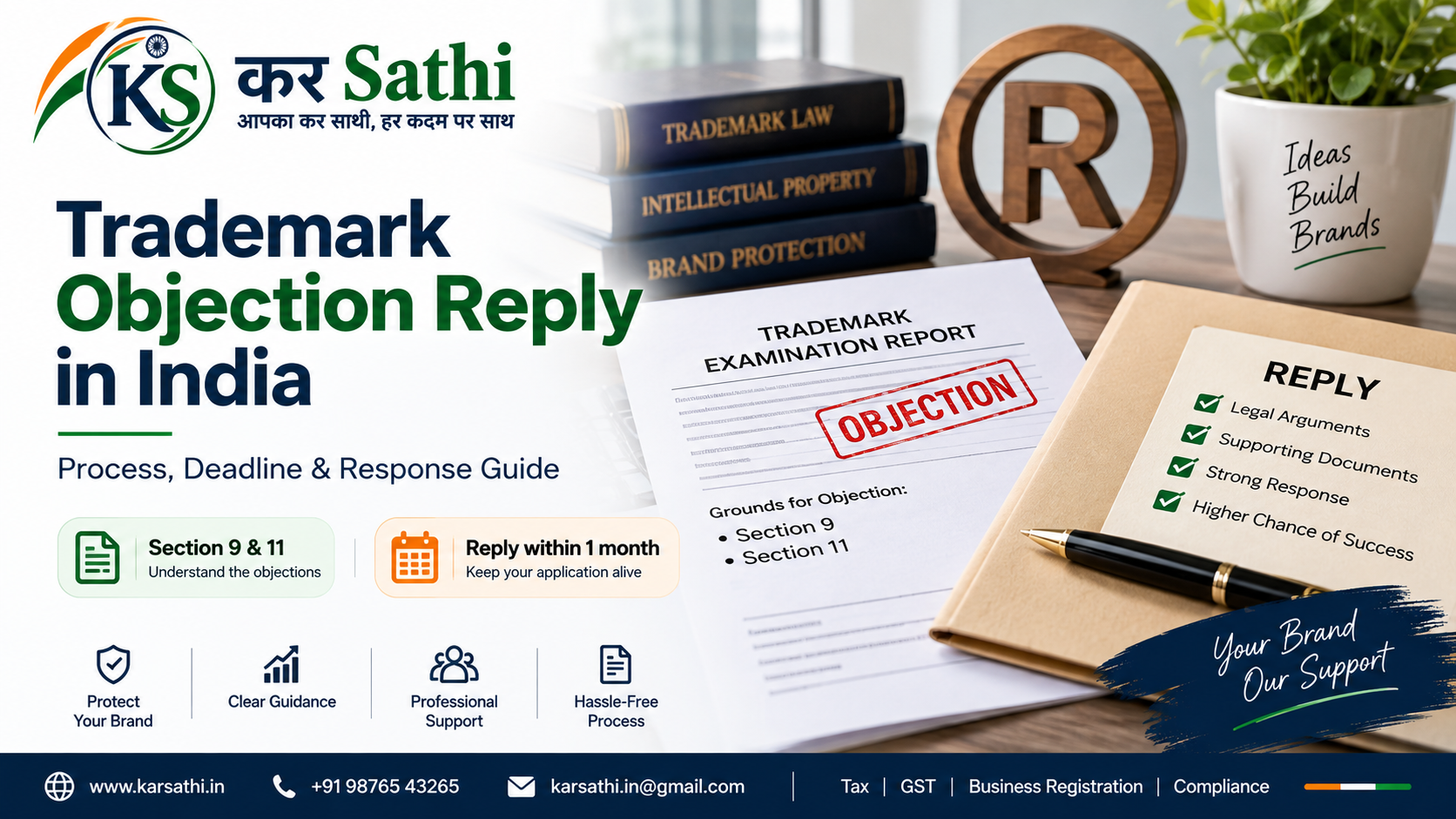
Trademark Objection Reply in India: Process, Deadline, Documents and Next Steps You applied for a trademark expecting the application to move toward registration, but the status.
Trademark Objection Reply in India: Process, Deadline, Documents and Next Steps
You applied for a trademark expecting the application to move toward registration, but the status suddenly shows “Objected.” For many business owners, this creates immediate concern that the brand has been rejected.
A trademark objection, however, is not a final rejection. It means the Trade Marks Registry has raised certain issues in the Examination Report and has given the applicant an opportunity to respond. What matters now is understanding the objection correctly and filing a well-prepared Trademark Objection Reply within the prescribed time.
Particular
Details
Issued By
Trade Marks Registry, IP India
Document
WHY CLIENTS CHOOSE KAR SATHI
✓ Tax Experts✓ Maximum Refund Assistance✓ Notice Support✓ Secure Documents✓ Transparent Pricing✓ Fast Turnaround
Copyright Registration for Trademarks in India: TM-C, Process, Fees and Documents
A business may already have a logo or brand identity and still wonder: “If I am applying for a trademark, do I also need copyright registration?” The confusion is common because.
Kar Sathi is an independent private platform and is not affiliated with, endorsed by, sponsored by, or authorized by any government entity. Government-related information provided by Kar Sathi is for informational purposes only. Users should verify information with the relevant official government source.
Official government source links
Use these official websites to verify current information:
No separate fee is specified under Rule 33 for the response itself; other separate requests may attract prescribed fees
Next Stage
Acceptance or Show Cause Hearing
If Reply Is Not Filed
Application may be treated as abandoned
Rule 33 of the Trade Marks Rules, 2017 provides that where the Registrar has an objection, it is communicated through an Examination Report. If the applicant does not respond within one month from receiving that report, the Registrar may treat the application as abandoned. (IP India)
What Is a Trademark Objection?
After a trademark application is filed, the Registry examines it and also searches earlier trademarks to identify identical or deceptively similar marks relating to the same or similar goods or services.
If the examiner finds an issue, the application may be marked as Objected, and an Examination Report is issued explaining the reasons. (IP India)
The applicant then gets an opportunity to explain why the trademark should be accepted.
An objection should not be confused with a Trademark Opposition. An objection is raised by the Registry during examination, while opposition is a separate proceeding that may arise after the trademark is published in the Trade Marks Journal. (IP India)
Why Does a Trademark Application Get Objected?
The two most common grounds are Section 9 and Section 11 of the Trade Marks Act, 1999.
Objection Under Section 9
Section 9 deals with absolute grounds for refusal. An examiner may object where the mark lacks distinctiveness, directly describes the goods or services, or consists of words commonly used in the trade. (IP India)
For example, a very descriptive expression used for the same product or service may face difficulty unless the applicant can establish a valid basis for registration.
Objection Under Section 11
Section 11 generally concerns conflicts with earlier trademarks.
An objection can arise where the applied mark is identical or similar to an earlier mark and the goods or services are also identical or similar, creating a likelihood of confusion or association among consumers. (IP India)
A Section 11 reply therefore needs more than a statement that “our mark is different.” The cited marks and the applicant’s mark need to be compared carefully.
Documents Required for Trademark Objection Reply
The exact documents depend on the objection raised, but commonly relevant records include
Trademark application number and Examination Report
Copy or representation of the applied trademark
Applicant and business details
Details of goods or services covered by the application
Information about trademarks cited by the examiner
Invoices showing use of the trademark, where relevant
Website pages, advertisements, brochures or promotional material
Evidence of earlier or continuous use, where relied upon
User affidavit and supporting documents, where applicable
Authorisation documents where the matter is handled through an authorised representative
Not every objection requires all of these documents. Evidence should support the specific arguments being made rather than simply adding unnecessary paperwork.
Step-by-Step Process for Filing a Trademark Objection Reply
Review the Examination Report
First identify the exact objection and the sections cited by the examiner.
Check whether the issue relates to distinctiveness, descriptiveness, an earlier trademark, the specification of goods or services, or another requirement.
Check the Cited Trademarks
Where Section 11 has been raised, examine the earlier marks referred to in the report.
The comparison may involve the overall appearance, pronunciation, meaning, nature of goods or services and the possibility of consumer confusion.
Prepare the Reply
Each objection should be answered separately with relevant factual and legal reasoning.
For a Section 9 objection, the response may address why the mark is distinctive or, where relevant, provide evidence supporting acquired distinctiveness.
For a Section 11 objection, the response should explain the differences between the marks and why the circumstances do not create the likelihood of confusion alleged in the report.
Attach Relevant Evidence
If the response relies on facts such as prior use, market presence or consumer recognition, suitable supporting material should be attached.
The evidence should also remain consistent with the information originally provided in the trademark application.
File Within the Prescribed Time
The reply should be submitted within one month from receipt of the Examination Report. Missing the period can put the application at risk of being treated as abandoned. (IP India)
Fees and Timeline
Rule 33 itself does not prescribe a separate fee simply for submitting the response to an Examination Report. IP India’s fee schedule separately identifies charges for forms and specific requests where a fee is applicable. (IP India)
If the reply is satisfactory, the Registrar may accept the application and proceed toward advertisement. If the response is not satisfactory, the applicant should be given an opportunity for a hearing. (IP India)
There is no guaranteed processing time after filing the reply, as the next stage depends on examination and Registry proceedings.
Practical Example
Suppose a business applies for the mark “NEXORA” and the Examination Report cites an earlier similar mark under Section 11.
Instead of filing a generic reply saying that the two names are different, the applicant should examine the cited trademark, the goods or services covered, the overall comparison between the marks and any other relevant circumstances.
A focused response based on the actual objection is far more useful than a standard template.
Common Mistakes to Avoid
Businesses commonly run into problems by
Ignoring the Examination Report
Missing the one-month reply period
Copying a generic objection reply
Failing to address every cited mark
Claiming trademark use without supporting evidence
Providing information inconsistent with the original application
Treating Section 9 and Section 11 objections as the same issue
Assuming that filing a reply guarantees acceptance
Failing to track the application after the reply is filed
Why Choose Kar Sathi?
A Trademark Objection Reply is not just a formal letter. The objection, cited trademarks and supporting evidence need to be examined together before preparing the response.
Kar Sathi can assist with reviewing the Examination Report, checking Section 9 or Section 11 objections, analysing cited marks, organising supporting documents and preparing the response for filing.
Where the Registry schedules a hearing after considering the reply, the application should also be monitored so that the next procedural step is not missed.
You may also internally link this article with your Trademark Registration Guide and Trademark Renewal Guide so readers can understand the complete trademark lifecycle.
Conclusion
Receiving a trademark objection does not mean that your application is finished. It means the Registry has raised an issue that needs a proper response.
The most important steps are to understand the exact objection, review the cited marks where applicable, prepare appropriate supporting evidence and respond within the prescribed one-month period.
Need help with a Trademark Objection Reply? Share your Trademark Application Number or Examination Report with Kar Sathi for professional assistance.
Official References
Trade Marks Act, 1999 — IP India
Trade Marks Rules, 2017 — IP India
Trademark Application Workflow — IP India
Trade Marks Forms & Official Fees — IP India
COMMON QUESTIONS
Answers before you file.
Trademark Objection Reply in India: Process, Deadline, Documents and Next Steps You applied for a trademark expecting the application to move toward registration, but the status suddenly shows “Objected.” For many business owners, this.
Tax & Compliance
Trademark Class Search in India: How to Choose the Right Class Before Filing
Choosing a trademark name is only one part of the registration process. A common problem arises when a business has a good brand name but files the application under the wrong.
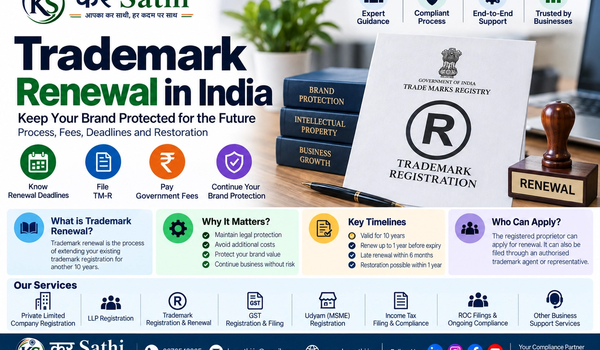
Trademark Renewal in India: Process, Fees, Deadlines and Restoration
A registered trademark can become one of the most valuable assets of a business. But many business owners assume that once a trademark is registered, the protection continues.