Trademark Registration: Complete Guide to Protect Your Brand in India
Your brand name, logo, tagline, or symbol is one of your business's most valuable assets. Trademark Registration gives your brand legal protection and prevents others from using a.
Published 22 April 20265 min readBy Kar Sathi Team
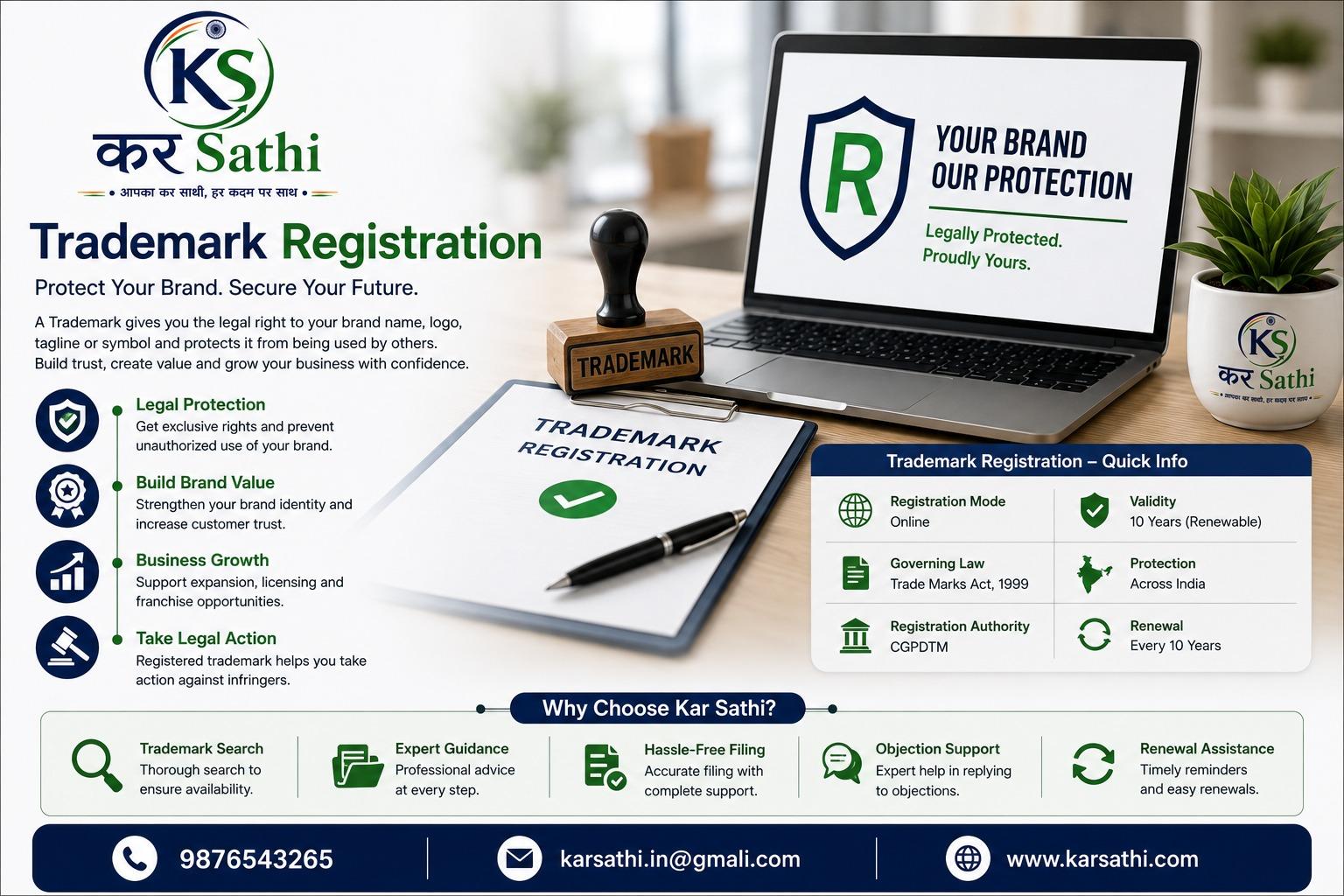
Your brand name, logo, tagline, or symbol is one of your business's most valuable assets. Trademark Registration gives your brand legal protection and prevents others from using a similar identity without your permission.
A registered trademark is issued under the Trade Marks Act, 1999 by the Controller General of Patents, Designs & Trade Marks (CGPDTM). Once registered, you gain exclusive rights to use the ™/® mark (® after registration) for your registered goods or services.
Quick Information
Particular
WHY CLIENTS CHOOSE KAR SATHI
✓ Tax Experts✓ Maximum Refund Assistance✓ Notice Support✓ Secure Documents✓ Transparent Pricing✓ Fast Turnaround
Copyright Registration for Trademarks in India: TM-C, Process, Fees and Documents
A business may already have a logo or brand identity and still wonder: “If I am applying for a trademark, do I also need copyright registration?” The confusion is common because.
Kar Sathi is an independent private platform and is not affiliated with, endorsed by, sponsored by, or authorized by any government entity. Government-related information provided by Kar Sathi is for informational purposes only. Users should verify information with the relevant official government source.
Official government source links
Use these official websites to verify current information:
Trademark Registration is the legal process of protecting your business identity. It ensures that your brand name, logo, slogan, product name, or symbol cannot be copied or misused by others.
A trademark helps customers identify your products and services while building trust and brand recognition in the marketplace.
Why is Trademark Registration Important?
Without trademark protection, another business may use a similar brand name or logo, causing customer confusion and potential financial loss.
Trademark Registration helps you
Protect your brand identity
Get exclusive ownership rights
Prevent unauthorized use
Build customer trust
Increase business value
Create a recognizable brand
Support franchise and licensing opportunities
Take legal action against infringement
Who Should Apply?
Trademark Registration is suitable for
Startups
Small Businesses
Private Limited Companies
LLPs
Partnership Firms
Sole Proprietors
E-commerce Sellers
Manufacturers
Service Providers
Professionals
Freelancers
Content Creators
Online Businesses
If you have a unique business name or logo, you should consider registering it as early as possible.
Eligibility Criteria
The following can apply for Trademark Registration
Individuals
Sole Proprietorships
Partnership Firms
Limited Liability Partnerships (LLPs)
Private Limited Companies
Public Limited Companies
Trusts
Societies
NGOs
Foreign Companies
Applicants should have a unique brand name, logo, slogan, or mark that does not conflict with existing registered trademarks.
Documents Required
Generally, you'll need
PAN Card
Aadhaar Card
Passport-size Photograph
Business Registration Certificate (if applicable)
GST Certificate (if available)
Logo in JPEG/PNG format (if registering a logo)
Address Proof
Power of Attorney (if filed through an authorized agent)
Pro Tip: Before applying, ensure your brand name is unique. A proper trademark search can save time and reduce the chances of objections.
Step-by-Step Registration Process
Step 1: Trademark Search
Search the trademark database to check whether your desired brand name or logo is already registered or similar to an existing trademark.
Step 2: Select the Correct Trademark Class
Identify the correct class based on the goods or services your business provides.
Step 3: Prepare the Application
Complete the application with applicant details, business information, trademark details, and supporting documents.
Step 4: File the Trademark Application
Submit the application online with the required government fee.
Step 5: Examination by the Trademark Office
The Trademark Office reviews the application and may issue an examination report if clarification is required.
Step 6: Publication in Trademark Journal
If accepted, the trademark is published in the Trademark Journal for public review and opposition, if any.
Step 7: Trademark Registration
If there is no successful opposition, the trademark is registered, and the Registration Certificate is issued.
Trademark Classes Explained
India follows the Nice Classification System consisting of 45 Trademark Classes.
Classes 1–34 cover Goods.
Classes 35–45 cover Services.
Examples
Business Type
Trademark Class
Clothing
Class 25
Restaurant
Class 43
Software & IT Services
Class 42
Education & Training
Class 41
Advertising & Marketing
Class 35
Medical Services
Class 44
Choosing the correct class is essential because trademark protection is granted only for the selected class(es).
Benefits of Trademark Registration
A registered trademark offers several long-term advantages
Exclusive ownership of your brand
Legal protection against infringement
Increased customer confidence
Stronger brand recognition
Valuable business asset
Easier expansion and franchising
Licensing opportunities
Improved business credibility
Nationwide protection
Long-term renewable rights
Common Mistakes to Avoid
Avoid these common errors during the registration process
Choosing a brand name similar to an existing trademark
Filing under the wrong trademark class
Submitting incomplete documents
Using poor-quality logo files
Ignoring examination notices
Delaying responses to objections
Assuming business registration automatically protects your brand
A careful application process significantly improves the chances of successful registration.
Why Choose Kar Sathi?
At Kar Sathi, we make Trademark Registration simple, transparent, and hassle-free.
Our services include
Trademark Search
Class Selection Guidance
Application Filing
Documentation Support
Expert Consultation
Objection Reply Assistance
Status Tracking
Renewal Assistance
Our experienced professionals ensure that your application is prepared accurately and filed efficiently, helping you protect your brand with confidence.
Conclusion
Your brand is one of your business's most valuable assets. Trademark Registration provides legal ownership, strengthens your market presence, and protects your identity from unauthorized use. Whether you're launching a startup, growing an online business, or expanding an established company, securing your trademark is a smart investment for long-term success.
With the right guidance and proper documentation, the registration process becomes simple and efficient. Kar Sathi is here to support you at every step, making it easier to safeguard your brand and focus on growing your business.
Frequently Asked Questions (FAQs)
1. How long is a Trademark Registration valid?
A registered trademark is valid for 10 years and can be renewed indefinitely every 10 years.
2. Can an individual apply for a trademark?
Yes. Individuals, startups, sole proprietors, companies, LLPs, and partnership firms can all apply for Trademark Registration.
3. Can I use the ™ symbol before registration?
Yes. You can use the ™ symbol after filing your trademark application. The ® symbol can only be used after the trademark is officially registered.
4. How long does the Trademark Registration process take?
The filing process is quick, but final registration depends on examination, publication, and any objections or oppositions. It may take several months to over a year.
5. Why should I register my trademark through Kar Sathi?
Kar Sathi provides end-to-end support, including trademark search, class selection, application filing, documentation, objection assistance, and regular status updates, making the process smooth and reliable.
COMMON QUESTIONS
Answers before you file.
Your brand name, logo, tagline, or symbol is one of your business's most valuable assets. Trademark Registration gives your brand legal protection and prevents others from using a similar identity without your permission. A registered.
Tax & Compliance
Trademark Class Search in India: How to Choose the Right Class Before Filing
Choosing a trademark name is only one part of the registration process. A common problem arises when a business has a good brand name but files the application under the wrong.
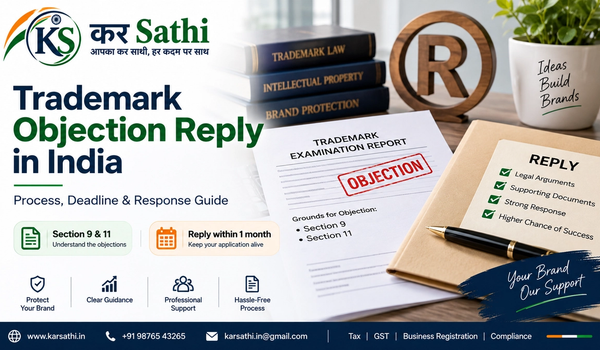
Trademark Objection Reply in India: Process, Deadline, Documents and Next Steps You applied for a trademark expecting the application to move toward registration, but the status.