Company Registration vs LLP in India: Which Business Structure Should You Choose?
Choosing the right business structure is one of the first important decisions an entrepreneur has to make. A business may have a good product, reliable customers and enough capital
Published 23 July 202611 min readBy Kar Sathi Team
Choosing the right business structure is one of the first important decisions an entrepreneur has to make. A business may have a good product, reliable customers and enough capital to get started, but selecting the wrong legal structure can create unnecessary compliance, ownership or funding problems later.
Two options that often create confusion are a Private Limited Company and a Limited Liability Partnership (LLP).
Both provide limited liability and a separate legal structure, but they are designed differently. A Private Limited Company is generally more suitable for businesses that want a corporate ownership model, issue shares, bring in investors and potentially scale aggressively. An LLP, on the other hand, combines limited liability with a partnership-style management structure and can work particularly well for professional and closely held businesses.
The right choice depends on what you want your business to look like three or five years from now—not simply which registration appears easier today.
WHY CLIENTS CHOOSE KAR SATHI
✓ Tax Experts✓ Maximum Refund Assistance✓ Notice Support✓ Secure Documents✓ Transparent Pricing✓ Fast Turnaround
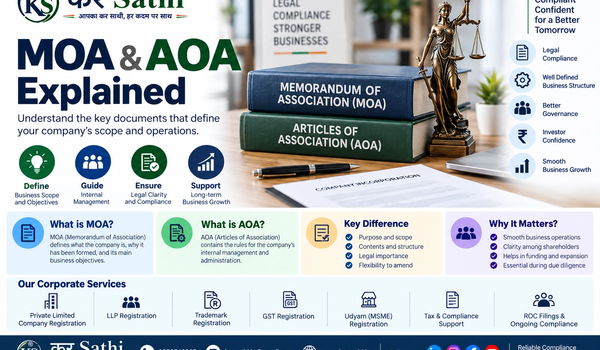
MOA & AOA Explained: A Simple Guide for Companies in India
When you register a company in India, two documents play a very important role—MOA (Memorandum of Association) and AOA (Articles of Association). These documents define what the.
Kar Sathi is an independent private platform and is not affiliated with, endorsed by, sponsored by, or authorized by any government entity. Government-related information provided by Kar Sathi is for informational purposes only. Users should verify information with the relevant official government source.
Official government source links
Use these official websites to verify current information:
A Private Limited Company is a company incorporated under the Companies Act, 2013.
It has a legal identity separate from its shareholders and directors. The shareholders own the company, while directors are responsible for managing its affairs.
For example, suppose Amit and Rahul start a technology business. They initially own 60% and 40% of the shares respectively. As the business grows, they may decide to bring in another investor by issuing or transferring shares in accordance with applicable law and agreements.
This share-based ownership structure is one reason companies are commonly considered by startups and businesses planning to raise equity capital.
What is an LLP?
An LLP, or Limited Liability Partnership, is a separate legal entity incorporated under the Limited Liability Partnership Act, 2008.
Instead of shareholders and directors, an LLP has partners and designated partners.
The rights, responsibilities, contribution and profit-sharing arrangements between partners are generally governed by the LLP Agreement, subject to applicable law.
An LLP can be useful where two or more people want to operate a business together but prefer a partnership-style structure along with limited liability.
Professional firms, consultants, agencies and closely held service businesses often consider LLPs for this reason.
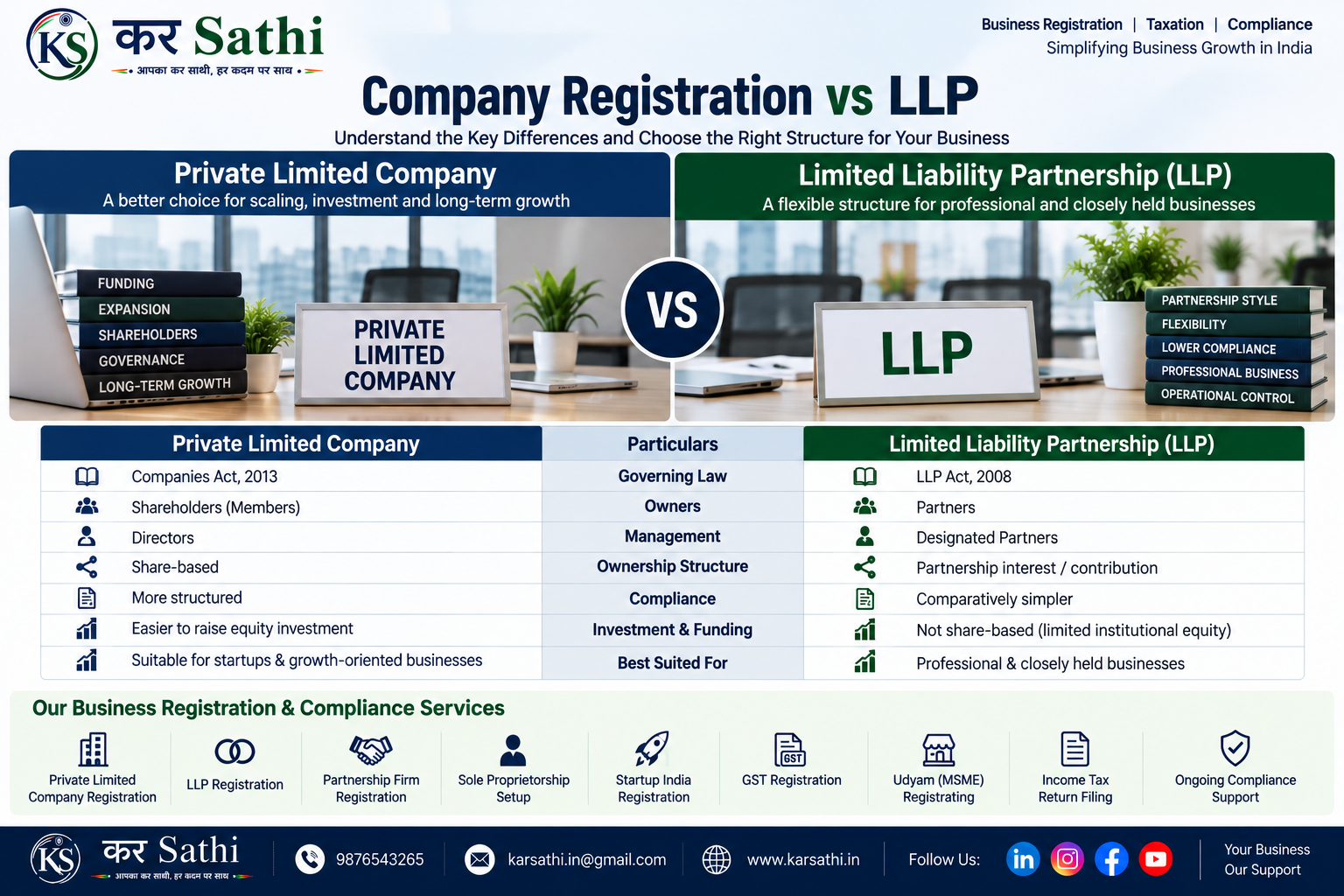
Company vs LLP: Quick Comparison
Particular
Private Limited Company
LLP
Governing Law
Companies Act, 2013
LLP Act, 2008
Legal Status
Separate Legal Entity
Separate Legal Entity
Liability
Limited, subject to law
Limited, subject to law
Owners
Shareholders/Members
Partners
Management
Directors
Designated Partners/Partners
Ownership Structure
Share-based
Partnership interest/contribution
Main Internal Document
MOA & AOA
LLP Agreement
Equity Investment Structure
Generally more suitable
Not share-based
Compliance
Generally more structured
Generally comparatively simpler
Suitable For
Startups & growth-oriented businesses
Professional & closely held businesses
This table gives a quick picture, but the practical differences matter much more when you're actually starting a business.
1. Ownership Structure
The first major difference is how ownership works.
Private Limited Company
A company has shareholders. Ownership is represented through shares.
For example
Amit – 50%
Rahul – 30%
Neha – 20%
The shareholding pattern provides a clear way to represent ownership.
This can be useful when new investors are expected to enter the business.
LLP
An LLP operates through partners.
Their contribution, rights, duties and profit-sharing arrangement are documented primarily through the LLP Agreement and applicable law.
An LLP does not operate using the same share-capital structure as a Private Limited Company.
Which is better?
If you expect to bring in equity investors, issue shares or create a conventional startup ownership structure, a Private Limited Company will generally be more suitable.
For a business that will remain closely held among a few partners, an LLP may be sufficient.
2. Limited Liability
Both structures offer an important advantage over a traditional proprietorship or partnership: limited liability, subject to applicable law.
In a company, shareholders' liability is generally limited according to the company's share structure and applicable provisions.
In an LLP, the liability of partners is generally limited to their agreed contribution, subject to statutory exceptions.
This separation can be particularly important when a business enters contracts, takes commercial risks or has substantial financial obligations.
However, “limited liability” should never be understood as complete immunity.
Fraud, personal guarantees, statutory violations and other circumstances can create personal consequences depending on the facts.
3. Separate Legal Entity
Both a Private Limited Company and an LLP have legal identities separate from their owners.
This means the entity can generally
Own assets
Enter contracts
Maintain bank accounts
Incur liabilities
Sue and be sued
Continue despite changes among owners/partners, subject to law
This is a major difference from a traditional sole proprietorship.
4. Registration Process
Both structures are formally registered through the corporate regulatory framework.
Private Limited Company Registration
A company incorporation generally involves matters such as
Proposed company name
Directors
Shareholders/subscribers
Registered office
Memorandum of Association
Articles of Association
Capital structure
Incorporation documentation
Once approved, the company receives its Certificate of Incorporation.
LLP Registration
LLP incorporation generally involves
Proposed LLP name
Partners
Designated Partners
Registered office
Contribution details
Incorporation documentation
LLP Agreement and related filing requirements
The LLP receives a Certificate of Incorporation after successful registration.
5. Compliance Requirements
Compliance is one of the biggest practical considerations for small businesses.
A Private Limited Company has a more formal corporate structure. It must maintain prescribed records and complete applicable ROC, accounting, statutory and tax compliances.
An LLP also has annual filing, accounting and tax obligations, but its corporate compliance framework is generally considered comparatively simpler.
This doesn't mean an LLP has “no compliance.”
Both structures require proper maintenance.
6. Raising Investment
This is where the difference becomes particularly important.
Suppose you are building an app and expect to raise ₹2 crore from investors after 18 months.
Investors may want a defined percentage of ownership.
A Private Limited Company has a share-based ownership structure designed to accommodate this kind of equity participation.
An LLP does not have shares in the same manner.
Therefore, businesses intending to pursue angel investment, venture capital or other conventional equity funding commonly prefer a Private Limited Company.
If external equity funding is not part of your plans, this advantage may be much less important.
7. Management and Decision-Making
A company's ownership and management can be separated.
Shareholders own the company, while directors manage its affairs according to applicable law and corporate documents.
In an LLP, partners have greater flexibility to determine management arrangements through the LLP Agreement.
For a small professional business where all owners are actively involved in operations, this flexibility can be useful.
8. Profit Distribution
In a company, profits belong to the company. Distribution to shareholders is governed by company law and tax provisions.
In an LLP, the profit-sharing arrangement between partners is typically specified in the LLP Agreement, subject to applicable law and taxation.
The tax treatment of companies, LLPs, dividends, partner remuneration and distributions is different.
Therefore, registration fees alone should never determine your decision.
A basic tax projection can sometimes show that the structure with the cheaper registration cost isn't necessarily the cheaper structure to operate.
9. Business Credibility
Both structures are formally registered business entities.
However, a Private Limited Company is often familiar to institutional investors, larger companies and startup ecosystems because of its corporate and shareholding structure.
An LLP can also have strong credibility, particularly for professional firms, consulting businesses and established service providers.
Credibility ultimately depends on much more than the letters written after the business name.
Turnover, financial statements, tax compliance, customers, management and business history matter as well.
10. Adding or Removing Owners
Businesses change over time.
A founder may leave. A new investor may join. A partner may retire.
In a company, ownership changes can be managed through shares, subject to the Companies Act, Articles, shareholder agreements and applicable procedures.
In an LLP, changes involving partners are handled under the LLP Agreement and applicable LLP provisions.
If frequent equity ownership changes are expected, a company's share structure is often more practical.
11. Startup India Recognition
Eligible Private Limited Companies and LLPs may apply for DPIIT Recognition under Startup India, provided they meet the applicable eligibility conditions.
Choosing a Private Limited Company does not automatically make the business a DPIIT-recognized startup.
Similarly, forming an LLP does not prevent an otherwise eligible business from applying simply because it is an LLP.
DPIIT Recognition is a separate process.
12. Taxation: Company vs LLP
Tax should be evaluated before choosing either structure.
A Private Limited Company is taxed according to the applicable corporate tax provisions and the tax regime selected or available to it.
An LLP is generally taxed as a firm under the applicable income-tax provisions.
There can also be differences in the taxation of amounts ultimately received by shareholders versus partners.
The best tax structure depends on expected profits, remuneration, reinvestment, distributions and other circumstances.
For a serious business, ask your tax professional to prepare a simple comparison using your expected numbers instead of choosing based on generic statements online.
When Should You Choose a Private Limited Company?
A Private Limited Company may be worth considering if
You plan to raise equity investment.
You're building a startup.
Multiple shareholders will own the business.
You expect the ownership structure to change.
You want to issue shares.
You expect institutional or venture-capital investment.
You want a formal corporate governance structure.
You're planning significant expansion.
For example, three founders developing a SaaS product and planning to raise venture capital would normally have strong reasons to consider a company structure.
When Should You Choose an LLP?
An LLP may be worth considering if
Two or more people want to operate the business together.
External equity funding is not a priority.
The business is closely held.
You prefer partnership-style internal management.
You run a professional or consulting business.
Limited liability is important.
You want comparatively flexible internal arrangements.
For example, three consultants starting a management advisory firm and planning to run it themselves without outside equity investors may find an LLP suitable.
Company vs LLP: A Practical Example
Imagine two friends, Arjun and Karan.
Both are starting businesses.
Arjun is building a technology platform. He expects to hire 30 employees and raise funding from investors within two years.
Karan is starting a consulting firm with another experienced professional. Both partners will work in the firm and share profits. They don't expect to raise outside equity capital.
Although both businesses have two founders, their requirements are very different.
For Arjun, a Private Limited Company may make more sense because of future investment and equity requirements.
For Karan, an LLP may provide the limited liability and operational flexibility he needs without creating a share-based corporate structure.
That's why asking, “Company or LLP—which is better?” is incomplete.
The better question is
“Which one is better for my business plan?”
Common Mistakes to Avoid
One of the most common mistakes is choosing a company simply because the word “Private Limited” sounds bigger.
Another is choosing an LLP only because someone said compliance is cheaper.
Business owners also make the mistake of ignoring future investors while selecting their initial structure.
Similarly, some founders focus entirely on tax rates without considering how profits will actually be withdrawn or reinvested.
Before registering, consider at least these four things
Ownership. Liability. Funding. Compliance.
Then consider taxation and long-term growth.
Documents Commonly Required
The exact documentation depends on the structure and circumstances, but founders should generally keep identification and address records ready.
For directors/partners, this can include PAN, Aadhaar or other applicable identity documents, photographs, email and mobile details, and address proof.
For the registered office, ownership documents or a rent/lease arrangement and appropriate supporting address documents may be required.
Additional declarations, consents, digital signatures and incorporation documents are required depending on the entity being formed.
Always check current requirements before filing.
Why Choose Kar Sathi?
At Kar Sathi, we don't believe every business should automatically be registered as a Private Limited Company.
The right structure depends on your actual plans.
We can help you compare a Private Limited Company and LLP based on your ownership, investment plans, expected business activity and compliance requirements before proceeding with registration.
Our business services include
Private Limited Company Registration
LLP Registration
Partnership Firm Registration
Sole Proprietorship Setup
Startup India / DPIIT Recognition
GST Registration
Udyam/MSME Registration
Trademark Registration
Income Tax Return Filing
GST Return Filing
TDS Compliance
Ongoing Business Compliance
The objective is to select a structure that still makes sense when your business grows—not simply one that is easy to register today.
Conclusion
Both Private Limited Companies and LLPs provide formal business structures with limited liability, but they serve different needs.
If you're building a scalable business, expect equity investment, or want a share-based ownership structure, a Private Limited Company will often be the more practical option.
If you're starting a closely held professional or service business with a few partners and don't expect conventional equity investment, an LLP can be an excellent alternative.
Don't choose between the two based only on registration cost.
Look at where the business is today, where you want it to be in five years, who will own it, how you expect to raise money, and how much compliance you're comfortable managing.
For assistance with Company Registration vs LLP selection, Private Limited Company Registration, LLP Registration, taxation, GST or ongoing business compliance, Kar Sathi can help you evaluate the options and set up the structure that fits your business.
COMMON QUESTIONS
Answers before you file.
Choosing the right business structure is one of the first important decisions an entrepreneur has to make. A business may have a good product, reliable customers and enough capital to get started, but selecting the wrong legal structure can
Tax & Compliance
Startup India Registration: Complete Guide to DPIIT Recognition for Startups in India
Starting a new business is exciting, but turning an idea into a properly structured and recognized startup takes more than just registering a company. New founders often hear terms
Sole Proprietorship Registration in India: A Complete Guide for Starting Your Business
Starting your own business is exciting, but the paperwork can quickly make things confusing. A new business owner usually has the same questions: Which registration do I need? Do I