OPC Registration in India: Process, Documents, Cost and Compliance
Starting a business on your own comes with an important decision: should you operate as a sole proprietor or register a company? A One Person Company, commonly called an OPC, gives
Published 15 July 202612 min readBy Kar Sathi Team
Starting a business on your own comes with an important decision: should you operate as a sole proprietor or register a company?
A One Person Company, commonly called an OPC, gives an eligible solo founder a way to establish a company without bringing in a second shareholder. It offers a separate legal identity and generally limited liability while allowing the founder to retain ownership.
However, an OPC also comes with ongoing responsibilities. Accounting, statutory audit and annual filings continue after incorporation, even when business activity is limited. Understanding these obligations before registering can help you choose a structure that fits your plans and budget.
WHY CLIENTS CHOOSE KAR SATHI
✓ Tax Experts✓ Maximum Refund Assistance✓ Notice Support✓ Secure Documents✓ Transparent Pricing✓ Fast Turnaround
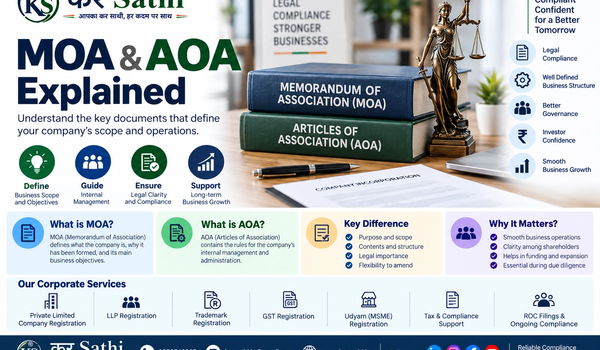
MOA & AOA Explained: A Simple Guide for Companies in India
When you register a company in India, two documents play a very important role—MOA (Memorandum of Association) and AOA (Articles of Association). These documents define what the.
Kar Sathi is an independent private platform and is not affiliated with, endorsed by, sponsored by, or authorized by any government entity. Government-related information provided by Kar Sathi is for informational purposes only. Users should verify information with the relevant official government source.
Official government source links
Use these official websites to verify current information:
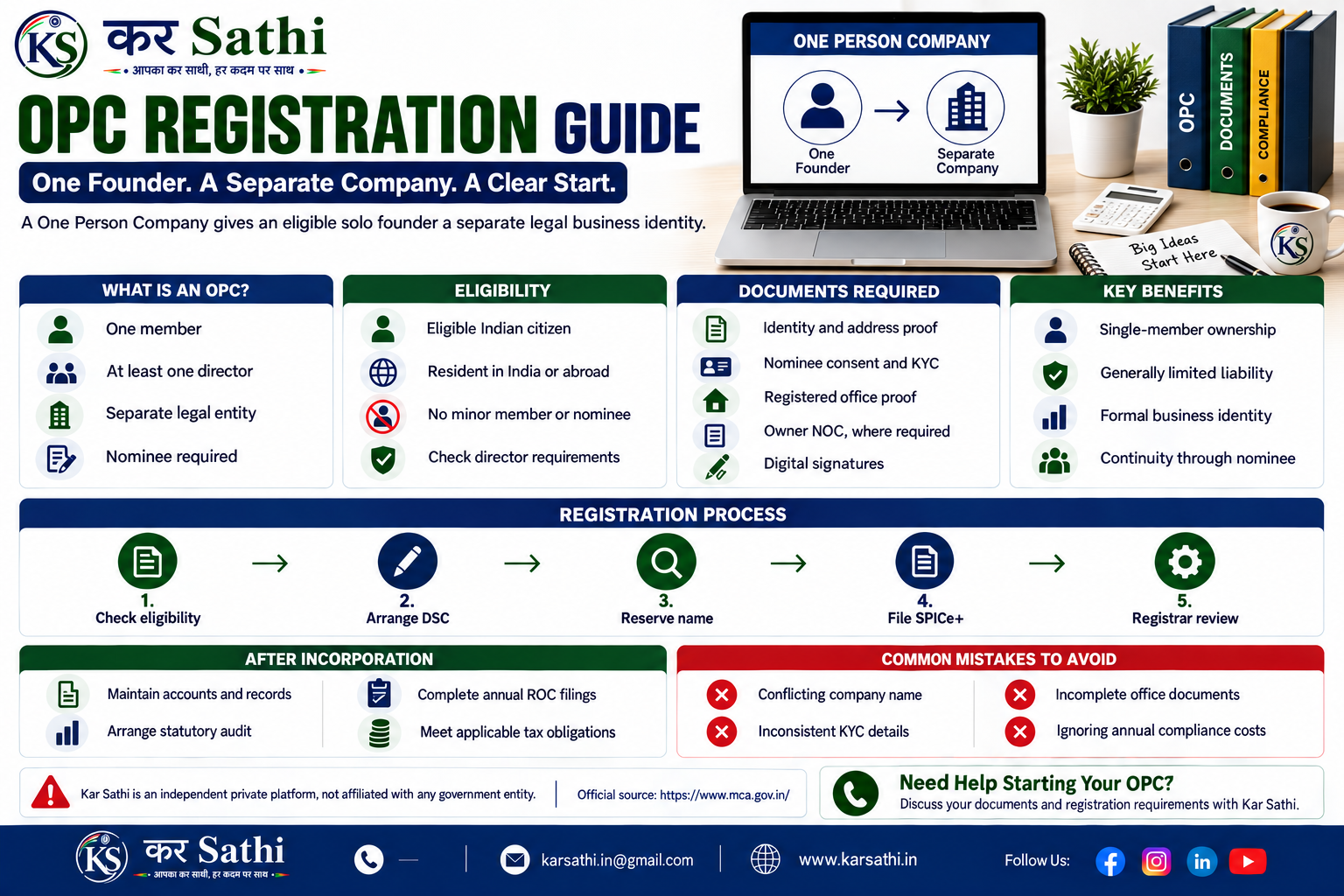
This guide explains OPC registration in India, the documents you should prepare, how the incorporation process works and what to consider before applying.
What Is a One Person Company
A One Person Company is a company with only one member. The member owns the company, while its directors manage the business. The same person can be both the sole member and a director.
An OPC has a legal identity separate from its owner. It can enter into contracts, hold assets and conduct business in its own name.
The basic structure includes
One eligible member or shareholder.
At least one director.
An eligible nominee who has given consent.
A registered office in India.
Incorporation under the Companies Act, 2013.
An OPC may have more than one director, but it cannot have more than one member while remaining an OPC.
Who Should Consider OPC Registration
An OPC may suit a consultant, freelancer, agency owner or other solo entrepreneur who wants to operate through a company.
For example, a consultant working with larger business clients may prefer to sign contracts and receive payments through a separate company. An OPC can provide that structure without requiring another person to become a shareholder.
Before choosing it, consider
Whether you intend to run the business alone.
The contractual and financial risks involved.
Whether clients require a company structure.
Whether you expect to introduce investors or co-founders.
Whether you can maintain accounts and meet annual compliance costs.
If you expect to add another shareholder soon, a regular private limited company may be more suitable from the beginning.
Eligibility for OPC Registration in India
The incorporation rules allow a natural person who is an Indian citizen, whether resident in India or otherwise, to incorporate an OPC. The proposed nominee must also satisfy the applicable eligibility conditions.
An eligible Indian citizen living abroad may therefore consider an OPC. Citizenship eligibility and the separate requirements relating to directors, documentation and overseas investment should be reviewed together.
Other restrictions include
A person cannot be a member of more than one OPC at the same time.
A person cannot be the nominee of more than one OPC at the same time.
A minor cannot become an OPC member or nominee.
An OPC cannot be incorporated or converted into a Section 8 company.
Certain non-banking financial investment activities are restricted.
An OPC must also meet the applicable requirements for its directors. Eligibility to own an OPC should not be confused with satisfying every requirement to manage and operate it.
Official reference: [MCA OPC amendment rules](https://www.mca.gov.in/Ministry/pdf/SecondAmndtRules_02022021.pdf).
Why an OPC Needs a Nominee
A nominee provides continuity if the sole member dies or becomes incapable of contracting.
Naming someone as a nominee does not automatically make that person a second shareholder or director. The nominee takes on the membership role when the circumstances specified by law arise.
The nominee must give consent, and the required details must be included in the incorporation records. A nominee can withdraw consent, and the member can change the nominee by following the prescribed procedure.
Choose someone who understands the responsibility and is willing to provide the necessary documents.
Benefits of Registering an OPC
A Separate Business Identity
The company exists separately from its owner. Contracts, assets, invoices and business records can be maintained in the company's name.
Generally Limited Liability
For an OPC limited by shares, the member's liability is generally limited to any unpaid amount on their shares.
This protection has limits. Personal guarantees, fraud and other unlawful conduct may create personal exposure. A company structure does not remove the need to assess contracts and borrowing arrangements carefully.
Ownership Without a Second Shareholder
A solo founder can retain ownership without adding a nominal shareholder simply to incorporate a company.
A Formal Structure for Business Relationships
A company structure can help meet the onboarding requirements of clients, vendors and financial institutions. Registration alone does not guarantee a loan, contract or business opportunity.
Continuity Through Nomination
The nominee arrangement provides a legal mechanism for continuity when the sole member dies or becomes incapable of contracting.
Limitations You Should Understand
The benefits of an OPC come with recurring costs and restrictions.
You will need to maintain company records, arrange statutory audit and complete applicable annual filings. These obligations do not disappear simply because the company has low turnover or no profit.
An OPC also cannot introduce a second shareholder while keeping its one-member structure. If your business needs equity investment from another person, conversion will generally be necessary.
For a small activity where simplicity is the main priority, a proprietorship may be easier to maintain. For a business with co-founders or near-term investment plans, a private limited company may offer more flexibility.
Documents Required for OPC Registration
The final checklist depends on the applicant, proposed directors and registered office. The following records are commonly required.
Member and Director Documents
PAN and applicable identity documents.
Current residential address proof.
Email address and mobile number.
Digital Signature Certificate for the required signatories.
Director Identification Number, if already allotted.
Required declarations and consent to act as director.
If a proposed director does not have a DIN, an application may be made through the incorporation process where permitted.
Overseas applicants may need additional authentication, notarisation or other documentation depending on their circumstances.
Nominee Documents
Applicable identity and address proof.
Contact details.
Consent in the prescribed form.
Other declarations required by the current incorporation process.
Registered Office Documents
Recent utility bill for the premises.
Ownership or occupancy documents, as applicable.
Rent or lease agreement where relevant.
The owner's no-objection certificate where required.
A residential address may be suitable if the company can provide the required documents and meet applicable requirements.
Make sure names, addresses and personal details are consistent across the application, identity records and digital signatures.
OPC Registration Process in India
New company incorporation is carried out through the Ministry of Corporate Affairs portal using SPICe+ and the applicable linked forms.
Step 1: Confirm the Business Structure
Review the proposed activity, ownership plan, registered-office location and compliance budget before preparing the application.
It is easier to resolve these questions at the beginning than to correct the structure after incorporation.
Step 2: Arrange Digital Signatures
The required signatories need Digital Signature Certificates to sign the electronic forms. Their MCA user profiles and DSC association should be completed as required by the current portal process.
Step 3: Choose and Check the Company Name
Prepare a distinctive name that fits the proposed business.
Check for conflicts with existing companies, LLPs and trademarks. A domain name being available does not mean the company name will be approved.
Name reservation is handled through SPICe+ Part A. It can be submitted separately or with the incorporation application.
Company records can be checked through [the MCA portal](https://www.mca.gov.in/). Trademark information can be checked through [IP India](https://ipindia.gov.in/).
Step 4: Prepare SPICe+ Part B
Part B covers the incorporation details, including the company structure, capital, registered office, subscriber and directors.
The integrated process also covers connected services such as PAN and TAN allotment. Other applications depend on the relevant linked forms and the company's circumstances.
Step 5: Prepare the Supporting Forms
The filing set includes constitutional documents, declarations, nominee details and supporting records.
The Memorandum of Association describes the company's objects. The Articles of Association set out its internal regulations.
The business objects should reflect what the company actually intends to do. Unrelated or regulated activities should not be included casually.
Step 6: Review and Submit the Application
The forms must be signed and professionally certified as required. Applicable fees and stamp duty are paid through the MCA filing process.
A careful review before submission can prevent avoidable errors in addresses, capital details, nominee consent and attachments.
Step 7: Respond to Any Resubmission Request
The Registrar may request clarification or corrected documents. Read the observations carefully and respond within the permitted period.
A resubmission request does not necessarily mean the business cannot be registered. It may relate to missing information or an inconsistency in the application.
Step 8: Receive the Incorporation Certificate
Once approved, the company receives its Certificate of Incorporation and Corporate Identity Number.
The next steps include completing banking arrangements, recording subscribed capital and setting up the company's compliance records.
Official process reference: [MCA SPICe+ and linked-filings FAQs](https://www.mca.gov.in/content/dam/mca/pdf/SPICEplus-and-linked-filings-FAQs-V3-20230122.pdf).
How Much Does OPC Registration Cost
OPC registration does not have one universal all-inclusive price.
The total can depend on
Authorised share capital.
State-specific stamp duty.
Separate name-reservation charges, where applicable.
Digital Signature Certificate charges.
Applicable filing and connected-service charges.
Professional fees.
Additional documentation or approvals.
A zero filing-fee concession, where available, does not mean the entire incorporation process is free. Stamp duty and other costs may still apply.
Ask for an itemised quotation showing government charges, stamp duty, professional fees and any services excluded from the package.
You should also ask about annual accounting, audit and ROC filing costs before deciding whether an OPC fits your budget.
Fee reference: [MCA SPICe+ instruction kit](https://www.mca.gov.in/Ministry/pdf/SPICe%2B_help.pdf). Confirm the final payable amount through the current MCA filing system.
How Long Does OPC Registration Take
There is no guaranteed approval timeline for every application.
The time required depends on document readiness, name approval, digital signatures, portal availability and whether the Registrar asks for corrections.
The most useful way to reduce delays is to prepare complete documents and resolve inconsistencies before submission.
Avoid making contractual commitments based solely on a promised incorporation date.
Compliance After OPC Registration
Registration creates an ongoing company-compliance responsibility.
Depending on the company's circumstances, the work may include
Maintaining accounting records and statutory registers.
Recording subscription money and issuing share certificates.
Filing the commencement-of-business declaration where applicable.
Recording member and director decisions.
Preparing financial statements.
Completing statutory audit.
Filing financial statements and annual returns with the Registrar.
Filing the company's income-tax return.
Completing applicable director KYC requirements.
Meeting GST and TDS obligations where applicable.
Reporting changes to directors, the nominee, office address or capital.
An OPC receives certain procedural relaxations, but it is not exempt from all company compliance.
Create a compliance calendar immediately after incorporation. Waiting until the first annual filing deadline can make missing records harder to reconstruct.
Is GST Registration Compulsory for an OPC
Incorporating an OPC does not, by itself, make GST registration mandatory in every case.
The requirement depends on turnover, the nature of supplies and other applicable conditions. Where registration is required or voluntarily chosen, the relevant application and continuing return obligations must be considered.
Check current requirements through the [official GST portal](https://www.gst.gov.in/) or obtain advice based on the business activity.
Common OPC Registration Mistakes
Choosing a Conflicting Name
A name may face objections if it is too similar to an existing company, LLP or trademark. Check the proposed name before spending money on branding.
Submitting Inconsistent Documents
Differences in spelling, addresses or personal details can lead to clarification requests. Review the complete document set together.
Treating Nominee Consent as a Formality
The nominee should understand the role. Missing consent or incorrect nominee details can delay incorporation.
Copying Business Objects Without Reviewing Them
The objects should match the company's intended activities. A broad collection of unrelated activities may create unnecessary questions.
Overlooking the Registered Office
The company needs proper evidence that it can use the premises. Confirm occupancy documents, owner consent and utility records early.
Budgeting Only for Registration
A low incorporation price can be misleading if annual audit and filing costs have not been considered. Assess the first year's overall cost.
Can an OPC Convert Into a Private Limited Company
Yes. An OPC can convert into a private limited company by meeting the applicable requirements and completing the prescribed filings.
This may become relevant when the founder wants to add a co-founder or bring in another shareholder.
Older articles may say that an OPC must convert when paid-up capital exceeds ₹50 lakh or average annual turnover exceeds ₹2 crore. Those thresholds belonged to the earlier compulsory-conversion framework, which was replaced by the 2021 amendment.
Conversion should be planned around the current rules and the proposed ownership structure.
Official reference: [Companies (Incorporation) Second Amendment Rules, 2021](https://www.mca.gov.in/Ministry/pdf/SecondAmndtRules_02022021.pdf).
Choosing the Right Structure for Your Business
An OPC can work well when you want to remain the sole owner while operating through a company.
Before applying, answer three practical questions
Will I remain the only shareholder for the foreseeable future?
Does the value of a company structure justify its annual compliance cost?
Have I considered the responsibilities that continue after registration?
Clear answers will help you choose a structure that supports the business as it grows.
Speak to Kar Sathi About OPC Registration
If you are considering OPC registration, start with a review of your business activity, ownership plans and documents.
Kar Sathi can help you understand the registration process and discuss the assistance required for your application.
[Contact Kar Sathi about OPC registration](https://karsathi.in/contact).
Government Information Sources and Disclaimer
Kar Sathi is an independent private platform and is not affiliated with, endorsed by, sponsored by, or authorised by any government entity. Government approvals remain under the control of the relevant authorities.
This article provides general information. Requirements, fees and filing procedures can change. Verify current information before applying.
Official government websites
Ministry of Corporate Affairs: [https://www.mca.gov.in/](https://www.mca.gov.in/)
IP India: [https://ipindia.gov.in/](https://ipindia.gov.in/)
Starting a business on your own comes with an important decision: should you operate as a sole proprietor or register a company? A One Person Company, commonly called an OPC, gives an eligible solo founder a way to establish a company.
Tax & Compliance
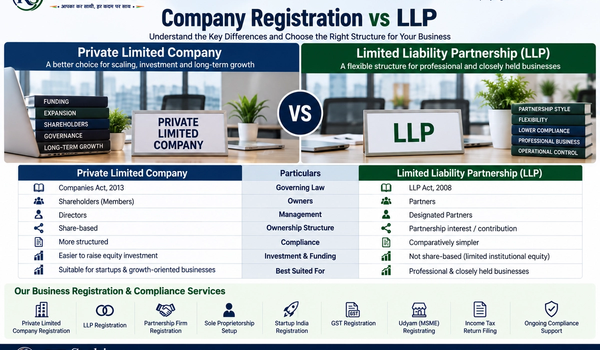
Company Registration vs LLP in India: Which Business Structure Should You Choose?
Choosing the right business structure is one of the first important decisions an entrepreneur has to make. A business may have a good product, reliable customers and enough capital
Startup India Registration: Complete Guide to DPIIT Recognition for Startups in India
Starting a new business is exciting, but turning an idea into a properly structured and recognized startup takes more than just registering a company. New founders often hear terms