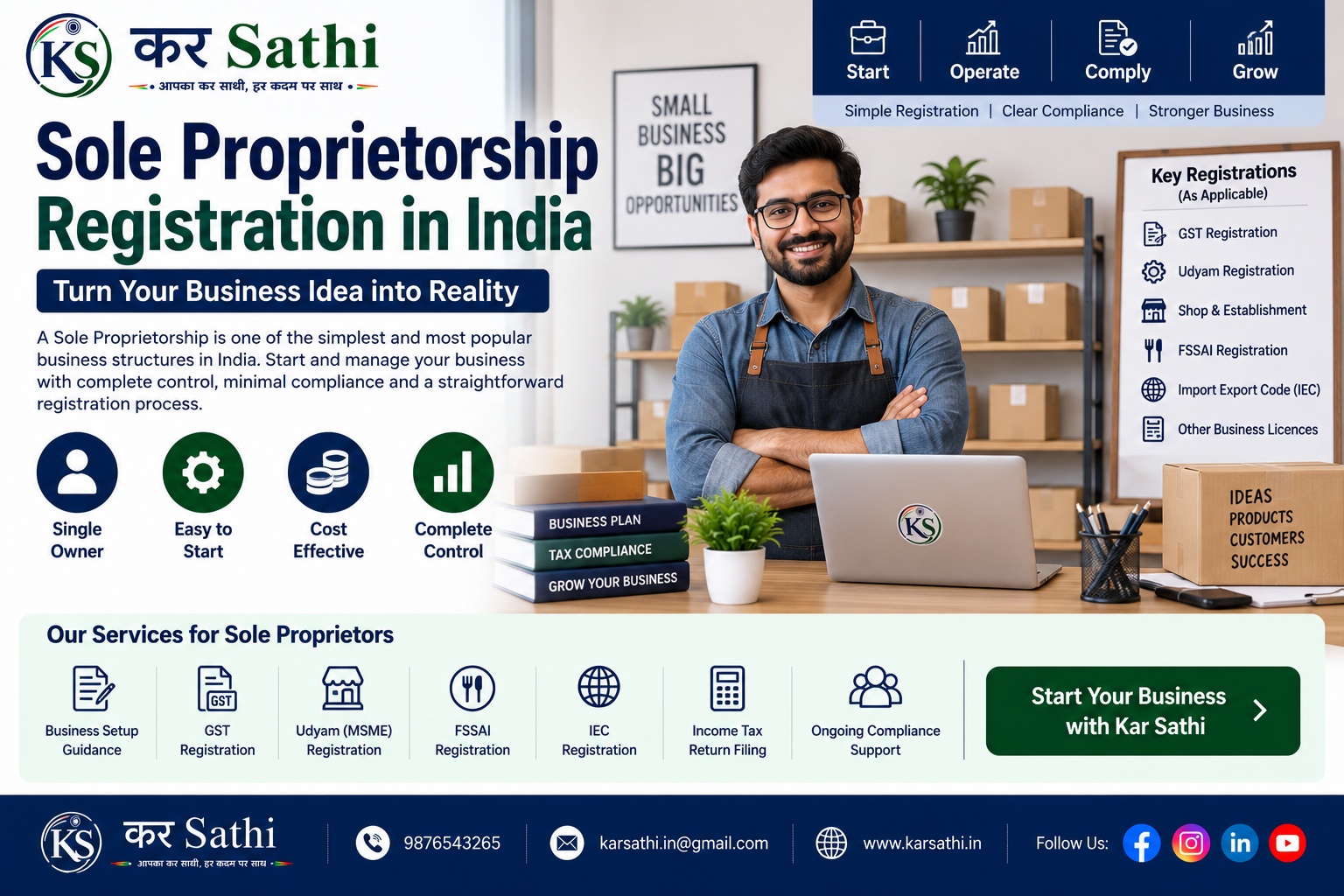
Sole Proprietorship Registration in India: A Complete Guide for Starting Your Business
Starting your own business is exciting, but the paperwork can quickly make things confusing. A new business owner usually has the same questions: Which registration do I need? Do I
Published 19 July 202612 min readBy Kar Sathi Team
Starting your own business is exciting, but the paperwork can quickly make things confusing. A new business owner usually has the same questions: Which registration do I need? Do I need GST? Should I register as a company? Can I start with my own PAN? And what exactly is a proprietorship firm?
If you're starting a small business on your own, a Sole Proprietorship is often one of the simplest ways to begin. It is widely used by shop owners, traders, freelancers, consultants, contractors, online sellers, small manufacturers and service providers.
WHY CLIENTS CHOOSE KAR SATHI
✓ Tax Experts✓ Maximum Refund Assistance✓ Notice Support✓ Secure Documents✓ Transparent Pricing✓ Fast Turnaround
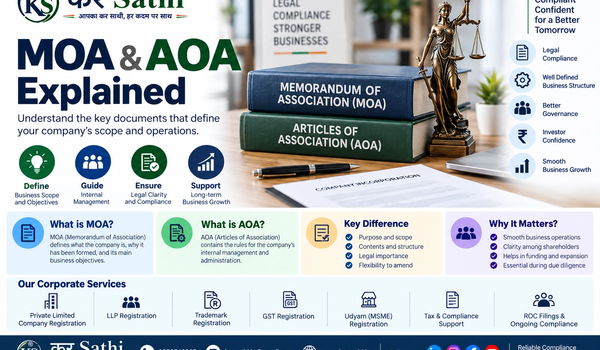
MOA & AOA Explained: A Simple Guide for Companies in India
When you register a company in India, two documents play a very important role—MOA (Memorandum of Association) and AOA (Articles of Association). These documents define what the.
Kar Sathi is an independent private platform and is not affiliated with, endorsed by, sponsored by, or authorized by any government entity. Government-related information provided by Kar Sathi is for informational purposes only. Users should verify information with the relevant official government source.
Official government source links
Use these official websites to verify current information:
The important thing is to understand that a proprietorship is not registered in exactly the same way as a Private Limited Company or LLP. There is no single incorporation certificate that creates every proprietorship business in India. Instead, the business establishes its identity through the registrations and licences applicable to its activities.
Here's how it works in practical terms.
What is a Sole Proprietorship?
A Sole Proprietorship is a business owned and managed by one individual. The owner is called the proprietor.
The proprietor invests money in the business, takes business decisions, receives the profits and is also responsible for the business's liabilities.
Suppose Ravi wants to open a wholesale electrical goods business under the name Ravi Electricals. He does not have a partner and wants to manage the entire business himself. Instead of immediately forming a company, he can operate the business as a proprietorship and obtain the registrations required for his particular activity.
The trade name may be Ravi Electricals, but Ravi remains the person behind the proprietorship.
Particular
Details
Business Type
Sole Proprietorship
Owners
One
Management
Controlled by Proprietor
Profit
Belongs to Proprietor
Liability
Generally Unlimited
Separate Incorporated Legal Entity
No
Best Suited For
Small & Owner-Managed Businesses
Is There a Sole Proprietorship Registration Certificate?
This is probably the most misunderstood part of proprietorship registration.
There is generally no single central registration called a “Sole Proprietorship Incorporation Certificate” similar to the Certificate of Incorporation issued to a company.
Instead, the registrations required depend on the business.
For example, one proprietorship may have GST Registration and Udyam Registration, while another may require FSSAI Registration because it operates a food business.
A shop may also have registration under the applicable Shops and Establishments law.
So before applying for anything, the business activity should be understood properly.
Getting unnecessary registrations only creates additional compliance later.
Who Should Choose a Sole Proprietorship?
A proprietorship is generally worth considering when there is only one owner and the business does not require a complicated ownership structure.
It is commonly used by
Shopkeepers and retailers
Traders and wholesalers
Freelancers
Consultants
Contractors
Small manufacturers
Online sellers
Digital marketing professionals
Designers
Home-based businesses
Food businesses
Independent professionals
Local service providers
For someone testing a new business idea with a relatively small investment, a proprietorship can also be a practical starting point.
However, business risk should also be considered. If the proposed business will take large loans, enter into high-value contracts or have substantial liability exposure, choosing a structure only because it is easy to start may not be the best decision.
Registrations a Proprietorship May Need
There is no fixed registration package that applies to every proprietorship. Requirements depend on the type of business, turnover, state and other circumstances.
GST Registration
GST Registration may be required when the business crosses the applicable registration threshold or falls under another provision requiring compulsory registration.
Some businesses may also choose voluntary GST registration where permitted.
Once GST registration is obtained, the proprietor should remember that ongoing GST compliance may begin. Registration should therefore not be taken casually just because a customer asks whether you have a GST number.
Udyam Registration
Eligible micro, small and medium enterprises can obtain Udyam Registration under the MSME framework.
It can provide formal MSME recognition and may help eligible businesses access schemes or benefits available to MSMEs.
FSSAI Registration or Licence
If you are starting a food-related business, an appropriate FSSAI Registration or Licence may be required depending on the nature and scale of operations.
This may apply to restaurants, food manufacturers, traders, cloud kitchens and various other food businesses.
Shops and Establishments Registration
A shop, office or commercial establishment may need registration under the Shops and Establishments law applicable in the relevant state.
Import Export Code
If the business intends to undertake import or export activities for which IEC is required, an Import Export Code (IEC) may need to be obtained.
Other industry-specific registrations or local licences can also apply.
Documents Required for a Sole Proprietorship
The exact documents depend on which registration you're applying for. However, it is useful to keep the basic records ready before starting.
For the proprietor, commonly required documents may include
PAN Card
Aadhaar Card
Photograph
Mobile Number
Email Address
Address Proof
For the business premises, documents may include
Electricity bill or other accepted address proof
Ownership documents, where applicable
Rent/lease agreement for rented premises
Owner's NOC, where required
Bank-related documents and business-specific supporting records may also be required depending on the registration.
Quick Tip
Before applying, compare your name, father's name, date of birth and address details across important documents. Even a small mismatch can sometimes result in additional verification or delays.
How to Start a Sole Proprietorship
The practical process is easier to understand when broken into steps.
Step 1: Decide Exactly What the Business Will Do
Don't begin with registration.
Begin with the business.
Are you opening a retail store? Selling online? Providing consultancy? Manufacturing a product? Running a restaurant? Importing goods?
Your answer determines which registrations and licences may be required.
Step 2: Choose Your Business Name
Select a business or trade name that is easy to remember and suitable for the work you plan to do.
For example
ABC Traders
ABC Consultancy
ABC Enterprises
But don't spend heavily on signage, packaging or marketing before considering whether the proposed brand name creates a trademark conflict.
A business name and a trademark are not automatically the same thing.
Step 3: Finalise the Business Address
Decide where the business will operate.
If the premises are rented, keep the rent agreement and supporting documents properly arranged. If they are owned, keep appropriate ownership/address records available.
Address documentation is commonly required across different registrations.
Step 4: Identify the Registrations You Actually Need
Now check the legal requirements based on your business.
A consultant working from home may have very different requirements from a restaurant.
Similarly, a local retailer and an importer will not necessarily need the same registrations.
This is why simply copying another business's registration list is a bad idea.
Step 5: Apply for the Applicable Registrations
Once you've identified what is required, submit the relevant applications with accurate information.
Check the spelling of the proprietor's name, PAN details, address and trade name before submitting anything.
Correcting mistakes later usually takes more effort than checking them properly at the beginning.
Step 6: Open a Current Account
After obtaining the documents required by your bank, you can approach it for a current account in the business/trade name, subject to the bank's KYC requirements.
Keeping business transactions separate from personal transactions is a good habit from day one.
If a customer pays your business, the money should be easy to identify in your records. The same applies to payments made to suppliers.
Step 7: Maintain Accounts from the First Day
This is where many small businesses go wrong.
For the first few months, the owner remembers every transaction and thinks formal records are unnecessary.
After a year, nobody remembers which ₹25,000 payment was for stock, which was a personal transfer and which customer still owes money.
Maintain proper
Sales records
Purchase bills
Expense vouchers
Bank transactions
Tax invoices
Stock records, where applicable
GST records, if registered
Good accounting isn't only useful for tax filing. It tells you whether your business is actually making money.
Advantages of a Sole Proprietorship
A proprietorship remains popular because it works well for many small businesses.
One Person Has Control
There are no partners to consult before every business decision.
The proprietor can decide pricing, suppliers, products, marketing and expansion plans independently.
Relatively Simple to Start
There is no company incorporation process merely to create a traditional proprietorship.
You identify and obtain the registrations applicable to your business.
Less Internal Formality
There are no shareholders or partnership meetings to manage simply because of the ownership structure.
Suitable for Small Businesses
For a shop, freelancer, consultant or small trader, a proprietorship may provide a straightforward structure without unnecessary complexity.
Easy to Understand
There is one owner. That person manages the business and receives its profits, subject to applicable tax and other obligations.
Disadvantages You Should Know Before Starting
A proprietorship is simple, but simplicity comes with trade-offs.
Personal Liability
One of the biggest differences between a proprietorship and a limited-liability structure is liability.
A traditional proprietorship does not provide the same separation between the business and owner that a company or LLP structure can provide.
If the business has substantial debts or legal liabilities, this can become important.
Only One Owner
A proprietorship cannot simply divide ownership shares among several people.
If you want to bring another person into the business as an owner, you may need to reconsider the structure.
Raising Investment Can Be Difficult
A startup planning to issue equity to investors generally needs a structure suitable for equity ownership.
A proprietorship is usually not designed for that purpose.
Business Depends Heavily on the Proprietor
The business and proprietor are closely connected, which can affect continuity and future restructuring.
Proprietorship vs Partnership vs LLP vs Private Limited Company
Suppose you're starting alone and expect to remain a small owner-managed business. A Sole Proprietorship may be sufficient.
If two people are starting together, a Partnership Firm may be considered.
Where multiple partners want a formal structure with limited liability, an LLP may be worth evaluating.
If you're planning to raise investment, issue ownership interests, build a larger corporate structure or scale aggressively, a Private Limited Company may be more suitable.
The right answer depends on what you want the business to become—not simply what costs the least to register today.
Income Tax for a Sole Proprietorship
A proprietorship is closely linked with the individual proprietor for income-tax purposes.
The business income is generally reported as part of the proprietor's taxable income in accordance with the applicable provisions of the Income-tax Act.
Depending on the business, turnover, income and other circumstances, the proprietor may also need to consider matters such as:
Income Tax Return Filing
Advance Tax
Tax Audit
TDS Compliance
Books of Accounts
Small businesses should not wait until the ITR due date to organize their accounts.
Keeping records throughout the year makes tax filing much easier.
GST After Registration
Getting a GST number is not the final step.
After GST registration, the business may have ongoing responsibilities relating to invoices, return filing, tax payment, Input Tax Credit and record keeping.
Even businesses with little or no activity should check whether returns are required for the relevant period.
Ignoring GST compliance after obtaining registration can eventually result in late fees, notices or cancellation-related issues.
Common Mistakes New Proprietors Make
The first is using the same bank account randomly for household and business transactions. It creates confusion during accounting and tax preparation.
The second is applying for registrations without understanding their future compliance requirements.
Another common mistake is starting under a business name without checking whether someone else has trademark rights over that name.
Some proprietors also fail to keep purchase invoices because they think only sales invoices matter. Purchase and expense documents can be equally important for accounting and tax purposes.
And perhaps the biggest mistake is assuming
“Business chhota hai, abhi records ki zarurat nahi hai.”
Small businesses become bigger. Reconstructing two years of missing records later is far more difficult than maintaining them properly from the beginning.
A Simple Example
Suppose Neha wants to start a home-based digital marketing consultancy.
She is the only owner and does not plan to bring in investors immediately.
Instead of automatically forming a Private Limited Company, she first evaluates whether a proprietorship suits her current needs.
She selects a trade name, arranges her business records, checks which registrations apply, opens an appropriate bank account, and starts maintaining invoices and expenses properly.
A year later, if the business grows significantly and she wants to bring in another owner or investor, she can evaluate whether moving to another structure makes sense.
The important point is that the business structure should match the actual stage and requirements of the business.
Before You Register: A Practical Checklist
Before starting, make sure you can answer these questions
What exactly will the business sell?
Where will the business operate?
Will you sell only locally or across India?
Will you sell through an e-commerce platform?
Will you import or export?
Do you need GST?
Does your activity require FSSAI or another licence?
Will you hire employees?
How will business payments be received?
Do you expect to bring in another owner or investor soon?
Answering these questions makes choosing the correct registration much easier.
Why Choose Kar Sathi?
At Kar Sathi, we understand that a new business owner usually doesn't want ten different registrations. They want to know which registrations they actually need and how to complete them correctly.
We assist with
Sole Proprietorship Setup
GST Registration
Udyam/MSME Registration
FSSAI Registration & Licence
Import Export Code (IEC)
PAN-related Services
GST Return Filing
Income Tax Return Filing
TDS Compliance
Business Tax & Compliance Support
We can review your business activity first and then help you understand the registrations and compliance requirements applicable to your situation.
Conclusion
A Sole Proprietorship can be an excellent starting point for someone who wants to run a business independently.
It is straightforward, flexible and suitable for many small businesses. But don't make the mistake of thinking that starting a proprietorship simply means obtaining one certificate.
Your actual requirements depend on what you sell, where you operate, your turnover and the laws applicable to your activity.
Choose the business structure carefully, obtain only the registrations you need, keep business and personal transactions organized, and maintain proper records from the beginning.
A business is much easier to grow when its foundation is clean.
If you need help with Sole Proprietorship Registration, GST Registration, Udyam, FSSAI, IEC, tax filing or ongoing business compliance, Kar Sathi can assist you from the initial setup through regular compliance.
COMMON QUESTIONS
Answers before you file.
Starting your own business is exciting, but the paperwork can quickly make things confusing. A new business owner usually has the same questions: Which registration do I need? Do I need GST? Should I register as a company? Can I start with.
Tax & Compliance
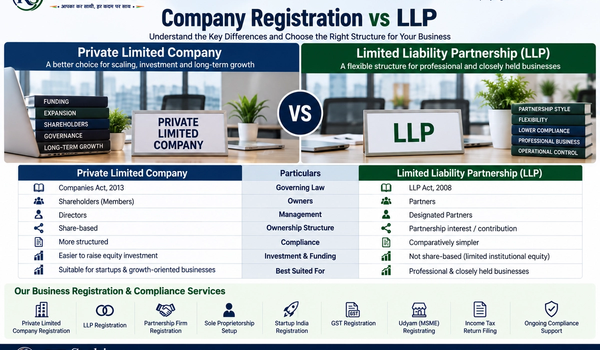
Company Registration vs LLP in India: Which Business Structure Should You Choose?
Choosing the right business structure is one of the first important decisions an entrepreneur has to make. A business may have a good product, reliable customers and enough capital
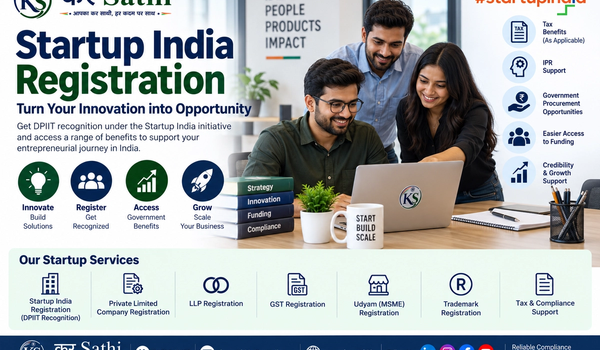
Startup India Registration: Complete Guide to DPIIT Recognition for Startups in India
Starting a new business is exciting, but turning an idea into a properly structured and recognized startup takes more than just registering a company. New founders often hear terms