Startup India Registration: Complete Guide to DPIIT Recognition for Startups in India
Starting a new business is exciting, but turning an idea into a properly structured and recognized startup takes more than just registering a company. New founders often hear terms
Published 21 July 202613 min readBy Kar Sathi Team
Starting a new business is exciting, but turning an idea into a properly structured and recognized startup takes more than just registering a company. New founders often hear terms such as Startup India Registration, DPIIT Recognition, tax exemption, funding, IPR benefits, and government tenders, but it can be difficult to understand what actually applies to their business.
One common misunderstanding is that every newly registered company automatically becomes a “Startup India” recognized startup. That is not the case.
An eligible business first needs to have an appropriate legal entity and then apply for recognition from the , subject to the applicable conditions.
WHY CLIENTS CHOOSE KAR SATHI
✓ Tax Experts✓ Maximum Refund Assistance✓ Notice Support✓ Secure Documents✓ Transparent Pricing✓ Fast Turnaround
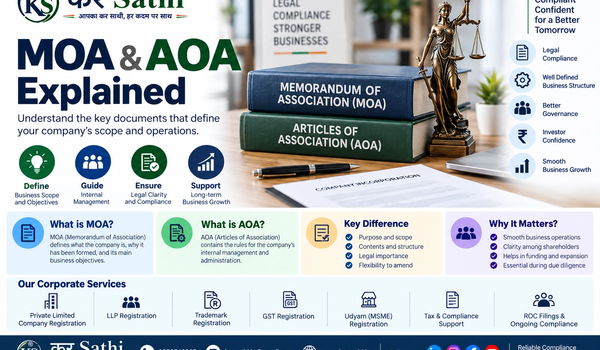
MOA & AOA Explained: A Simple Guide for Companies in India
When you register a company in India, two documents play a very important role—MOA (Memorandum of Association) and AOA (Articles of Association). These documents define what the.
Kar Sathi is an independent private platform and is not affiliated with, endorsed by, sponsored by, or authorized by any government entity. Government-related information provided by Kar Sathi is for informational purposes only. Users should verify information with the relevant official government source.
Official government source links
Use these official websites to verify current information:
Department for Promotion of Industry and Internal Trade (DPIIT)
If you're building an innovative product, service, process, or scalable business model, Startup India recognition can be useful as your business grows.
This guide explains Startup India Registration in practical terms: what it is, eligibility, documents, the registration process, benefits, common mistakes, and what founders should know before applying.
What is Startup India?
Startup India is an initiative of the Government of India aimed at supporting entrepreneurship, innovation, and the development of the startup ecosystem.
Under the initiative, eligible entities can apply for DPIIT Recognition.
Recognition can help eligible startups access various benefits and facilitation measures available under applicable government rules and schemes.
The important distinction is
Company/LLP registration creates your business entity. DPIIT Recognition recognizes an eligible entity as a startup under the Startup India framework.
These are not the same registration.
Particular
Details
Initiative
Startup India
Recognition
DPIIT Recognition
Applicable To
Eligible Entities
Application Mode
Online
Main Purpose
Recognition & Startup Ecosystem Support
Authority
Department for Promotion of Industry and Internal Trade (DPIIT)
Automatic Tax Exemption
No – separate eligibility/conditions may apply
What is DPIIT Recognition?
DPIIT stands for the Department for Promotion of Industry and Internal Trade.
When people talk about “Startup India Registration,” they are often referring to obtaining DPIIT Recognition.
The recognition process examines whether the applicant satisfies the applicable Startup India eligibility requirements.
Once recognized, an eligible startup may be able to access benefits or relaxations provided under different laws, schemes, and government programs, subject to their individual conditions.
This last point matters.
Receiving a DPIIT Recognition Certificate does not mean that every Startup India benefit automatically becomes available to the business.
Some benefits require separate applications or have their own eligibility requirements.
Who is Eligible for Startup India Recognition?
Before applying, founders should check whether their entity meets the current eligibility conditions.
Broadly, eligibility is linked to factors such as the type of entity, age of the entity, turnover, nature of business, and innovation or scalability.
Eligible entity types can include prescribed forms of incorporated businesses such as
Private Limited Company
Limited Liability Partnership (LLP)
Registered Partnership Firm
The entity should also meet the applicable conditions relating to the period since incorporation/registration and turnover.
Most importantly, the business should generally be working towards innovation, development or improvement of products, processes or services, or have a scalable business model with potential for employment generation or wealth creation, as prescribed.
Simply opening a normal business and calling it a startup does not automatically satisfy these requirements.
Is a Sole Proprietorship Eligible for Startup India Recognition?
This is a useful question for founders who have started small.
A traditional Sole Proprietorship is not one of the prescribed entity forms for DPIIT Startup Recognition.
Therefore, if you're currently operating as a proprietorship and want to pursue Startup India recognition, you may need to evaluate an eligible business structure.
However, don't convert or restructure a business only to obtain a certificate.
Consider liability, taxation, ownership, investment plans, compliance cost, and long-term business goals before choosing between a Private Limited Company, LLP, or another suitable structure.
Startup India Registration vs Company Registration
These two are frequently confused.
Suppose three founders have an idea for software that helps small manufacturers reduce energy consumption.
They incorporate ABC Technologies Private Limited.
At this stage, they have a legally incorporated company.
That does not automatically mean the company has DPIIT Startup Recognition.
If the company meets the applicable Startup India conditions, it can separately apply for DPIIT Recognition.
So, practically
Business Incorporation → Business Starts Operations → Check Startup Eligibility → Apply for DPIIT Recognition
Understanding this sequence prevents a lot of confusion.
Documents and Information Required
The exact requirements should always be checked at the time of application because government procedures can change.
Generally, applicants should keep their entity and business information properly organized.
This may include
Certificate of Incorporation or Registration
Entity PAN
Details of Directors/Partners
Registered Office Details
Business Contact Information
Website details, where applicable
Information about the startup's activities
Details explaining innovation or improvement
Description of the business model
Supporting information/documents, where applicable
Authorization and other prescribed information
The most important part is often not uploading basic documents. It is explaining the business properly.
Your Startup Description Matters
Founders sometimes treat the business description as a formality and write something vague such as
“We are an innovative company providing the best services to customers.”
That doesn't explain anything meaningful.
A better description should answer practical questions
What problem are you solving?
How does your product or service solve it?
What is different about your approach?
Is there an innovation or meaningful improvement?
Can the business scale?
Can it potentially generate employment or create economic value?
Write what the business actually does. Don't fill the application with words such as “revolutionary,” “disruptive,” and “world-class” unless you can explain the substance behind them.
A simple, factual description is usually much stronger than marketing language.
Step-by-Step Startup India Registration Process
The exact online interface may change over time, but the practical preparation process can be understood in the following stages.
Step 1: Choose the Correct Business Structure
If the business hasn't been registered yet, first decide which legal structure makes sense.
For startups planning to raise equity investment, a Private Limited Company is commonly considered because its ownership structure can accommodate shareholders.
For certain professional or founder-owned businesses, an LLP may be worth considering.
Do not choose a structure only because someone says it is required for “Startup India.”
Choose it based on the actual business plan.
Step 2: Incorporate or Register the Entity
Complete the applicable incorporation or registration process and obtain the entity's legal documents.
Keep the entity name, registered office, founder details, and business activity consistent across your records.
Step 3: Check DPIIT Eligibility
Before applying, review the latest Startup India eligibility requirements.
Check the entity type, age, turnover conditions, and the innovation/scalability criteria.
If the business clearly doesn't meet the requirements, submitting a weak application merely to obtain a certificate is not a good approach.
Step 4: Prepare the Business Information
This is where founders should spend time.
Write a clear description covering
The problem
Your solution
Target customers
Product or service
Innovation/improvement
Revenue model
Scalability
Potential economic or employment impact
If you have a website, prototype, product screenshots, pitch deck, patent-related information, customer traction, or other relevant evidence, keep it organized wherever it is useful and permitted.
Step 5: Submit the Recognition Application
The eligible entity can submit the Startup India/DPIIT Recognition application through the applicable government platform.
All information should be accurate and supported by the entity's records.
Never make false claims about patents, innovation, customers, revenue, funding, or technology merely to make an application look stronger.
Step 6: Complete Verification
The application is processed according to the applicable procedure.
If additional clarification or information is requested, respond carefully and within the applicable timeline.
Step 7: Obtain DPIIT Recognition
Once the application is successfully processed and approved, the entity receives DPIIT Startup Recognition.
Keep the recognition details and certificate safely with the company's compliance records.
What Are the Benefits of Startup India Recognition?
This is usually the main reason founders apply.
The Startup India framework provides various forms of support and facilitation to eligible recognized startups, but each benefit should be checked separately.
Intellectual Property Support
Eligible recognized startups may receive facilitation or benefits relating to intellectual property rights, such as patents and trademarks, subject to the applicable scheme and conditions.
For a technology or product-based startup, protecting intellectual property early can be important.
Government Procurement Opportunities
Recognized startups may receive certain relaxations or facilitation in government procurement under applicable rules.
This can be valuable for businesses selling products or services to government organizations.
However, DPIIT Recognition should not be treated as a guarantee of winning government contracts.
Tax-Related Benefits
Certain eligible startups may be able to apply for specific tax benefits under the Income-tax Act, subject to separate conditions, approvals, prescribed periods, and applicable law.
This point is often misrepresented online.
DPIIT Recognition does not mean your startup automatically becomes tax-free.
Always check the particular tax provision separately.
Startup Ecosystem Access
Recognition can help founders participate in parts of the government-supported startup ecosystem, including programs, opportunities, information resources, or initiatives available to eligible startups.
Credibility
For a genuinely innovative business, formal recognition may also add credibility when dealing with stakeholders.
But recognition should support a strong business—not replace one.
Does Startup India Give You Funding?
Another common misconception is
“Startup India registration kara lo, government funding mil jayegi.”
It isn't that simple.
DPIIT Recognition does not automatically deposit funding into the startup's bank account.
Funding opportunities may exist through different government schemes, funds, incubators, financial institutions, investors, or programs. Each has separate eligibility and selection requirements.
A startup seeking funding should still prepare the fundamentals
Business plan
Pitch deck
Financial projections
Founder profile
Market opportunity
Revenue model
Product roadmap
Use of funds
Customer traction, where available
A certificate cannot replace a viable business model.
Startup India and Tax Exemption: Understand the Difference
This area deserves extra attention.
Startup founders often see advertisements claiming
“Get Startup India Certificate and pay no tax.”
That statement can be misleading.
DPIIT Recognition and eligibility for a particular income-tax benefit are separate matters.
Tax incentives may be available only where the startup meets the prescribed conditions and completes any additional process required under the applicable provision.
Therefore, before making financial projections assuming a tax exemption, verify the current law and your actual eligibility.
Common Mistakes While Applying
Many applications become unnecessarily difficult because founders rush the process.
Choosing the Wrong Entity
A founder operating through an ineligible structure may attempt to apply without first understanding the entity requirements.
Weak Business Description
Simply saying “we provide innovative solutions” does not explain the innovation.
Copying Another Startup's Description
Your application should describe your business, not a generic startup.
Incorrect Incorporation Information
Company name, registration number, dates, PAN, and founder details should match official records.
Assuming Every Benefit Is Automatic
DPIIT Recognition is not an automatic approval for every funding, tax, tender, or IPR benefit.
Making Unsupported Claims
Do not claim patents, proprietary technology, revenue, customers, or partnerships that do not exist.
Accurate information is always safer than exaggerated marketing language.
What Should You Do After Getting Recognition?
Getting the certificate should not be treated as the finish line.
Your startup still needs to maintain normal business compliance.
Depending on the entity and activities, this may include
Income Tax Return filing
GST compliance
TDS returns
Accounting and bookkeeping
ROC compliance for companies
LLP compliance, where applicable
Payroll-related compliance
Trademark and IP protection
Business licences
Contract documentation
A startup can have a great product and still run into problems if basic compliance is ignored.
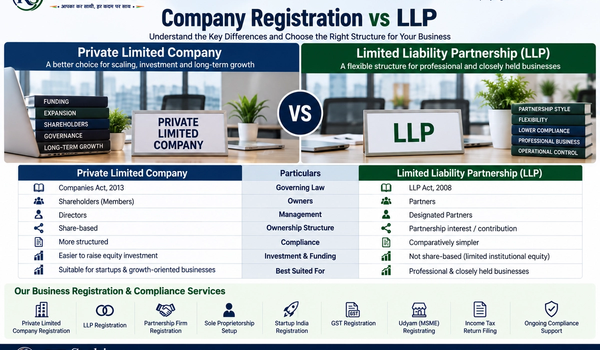
Private Limited Company or LLP for a Startup?
There is no universal answer.
If the founders expect to raise equity investment, issue shares, onboard investors, or build a conventional venture-backed startup, a Private Limited Company is often considered.
An LLP can be useful where founders want limited liability with a partnership-style structure and do not require a traditional shareholding model.
A Registered Partnership Firm may suit certain smaller businesses, although founders should carefully consider liability and future funding plans.
Your decision should be based on where the business is heading over the next few years, not just today's registration cost.
A Practical Startup Example
Suppose two engineers develop software that helps logistics companies optimize delivery routes and reduce fuel usage.
They plan to build the software as a subscription product and sell it to businesses across India.
Before registering anything, they discuss ownership and future funding.
They choose an appropriate entity, complete incorporation, open a business bank account, maintain accounting records, and begin product development.
When preparing their DPIIT Recognition application, instead of simply writing
> “We are an innovative logistics company.”
They explain the actual problem—inefficient route planning—and describe how their technology helps businesses optimize routes, reduce unnecessary travel, and improve fleet utilization.
That tells the reader what the startup actually does.
This is the approach founders should take.
Quick Checklist Before Applying
Before submitting your Startup India application, verify the basics
Is your entity type eligible?
Does the entity satisfy the applicable age criteria?
Does it satisfy the applicable turnover conditions?
Can you clearly explain your innovation or improvement?
Is your business model scalable where relevant?
Are incorporation details correct?
Are founder/director/partner details updated?
Can your claims be supported?
Have you understood which benefits require separate applications?
If you cannot clearly explain what makes the business eligible, work on that before submitting the application.
Why Choose Kar Sathi?
Startup registration isn't just about obtaining a certificate. Founders need the right business structure, correct documentation, tax registrations, and ongoing compliance as the business grows.
At Kar Sathi, we assist entrepreneurs with the complete business setup and compliance journey.
Our services include
Startup India / DPIIT Recognition Assistance
Private Limited Company Registration
LLP Registration
Partnership Firm Registration
GST Registration
Udyam/MSME Registration
Trademark Registration Assistance
Income Tax Return Filing
GST Return Filing
TDS Compliance
Business Compliance Support
Startup Documentation Guidance
We first understand the business and then help identify the registrations and compliance requirements that actually apply.
Conclusion
Startup India Registration can be valuable for eligible innovative and scalable businesses, but founders should understand what the recognition actually means.
Registering a Private Limited Company or LLP does not automatically give you DPIIT Recognition. Similarly, receiving DPIIT Recognition does not automatically provide funding or every tax benefit.
The process starts with choosing the right business structure, checking eligibility, and explaining your business accurately.
If your startup genuinely solves a problem, improves an existing product or process, introduces innovation, or has a scalable model with potential to create employment or economic value, DPIIT Recognition may be worth exploring.
Build the business first. Keep the paperwork accurate. And don't chase certificates without understanding what they are meant to do.
For assistance with Startup India Registration, DPIIT Recognition, Company Registration, LLP Registration, GST, Trademark, taxation, or ongoing startup compliance, Kar Sathi can help you through the process from setup to regular compliance.
COMMON QUESTIONS
Answers before you file.
Starting a new business is exciting, but turning an idea into a properly structured and recognized startup takes more than just registering a company. New founders often hear terms such as Startup India Registration, DPIIT Recognition, tax.
Tax & Compliance
Company Registration vs LLP in India: Which Business Structure Should You Choose?
Choosing the right business structure is one of the first important decisions an entrepreneur has to make. A business may have a good product, reliable customers and enough capital
Sole Proprietorship Registration in India: A Complete Guide for Starting Your Business
Starting your own business is exciting, but the paperwork can quickly make things confusing. A new business owner usually has the same questions: Which registration do I need? Do I