Partnership Firm Registration in India: Complete Guide for Starting a Partnership Business
Starting a business with someone you trust can make the journey easier. One partner may be good at handling customers, another may understand finance, while someone else may manage
Published 17 July 202613 min readBy Kar Sathi Team
Starting a business with someone you trust can make the journey easier. One partner may be good at handling customers, another may understand finance, while someone else may manage day-to-day operations. But when two or more people decide to run a business together, verbal understanding alone is not enough. The roles, investment, profit-sharing arrangement, responsibilities, and exit terms should be clearly documented from the beginning.
This is where a Partnership Firm becomes useful.
A partnership is one of the traditional and practical business structures in India. It is commonly used by small businesses, traders, wholesalers, service providers, family-run businesses, professionals, and people starting a venture together without immediately setting up a company or LLP.
The registration process is comparatively straightforward, but the important part is getting the and supporting documents right. A poorly drafted deed can create problems later, especially when there is a disagreement between partners, a change in ownership, or a question about profit sharing.
WHY CLIENTS CHOOSE KAR SATHI
✓ Tax Experts✓ Maximum Refund Assistance✓ Notice Support✓ Secure Documents✓ Transparent Pricing✓ Fast Turnaround
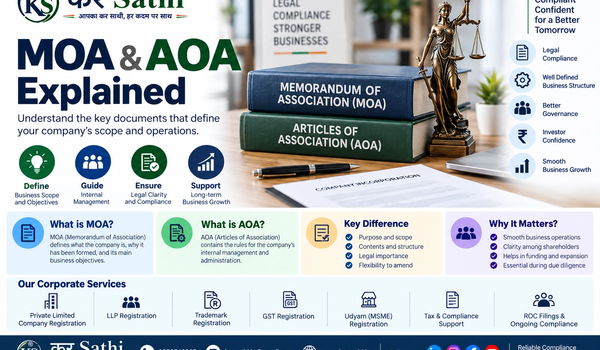
MOA & AOA Explained: A Simple Guide for Companies in India
When you register a company in India, two documents play a very important role—MOA (Memorandum of Association) and AOA (Articles of Association). These documents define what the.
Kar Sathi is an independent private platform and is not affiliated with, endorsed by, sponsored by, or authorized by any government entity. Government-related information provided by Kar Sathi is for informational purposes only. Users should verify information with the relevant official government source.
Official government source links
Use these official websites to verify current information:
This guide explains Partnership Firm Registration in India in simple language, including how a partnership works, the documents required, registration steps, advantages, limitations, and the points you should discuss with your partners before starting.
What is a Partnership Firm?
A Partnership Firm is a business arrangement in which two or more persons agree to carry on a business and share its profits according to mutually agreed terms.
The relationship between the partners is generally recorded in a Partnership Deed. This document becomes one of the most important records of the business because it sets out how the partnership will actually operate.
For example, suppose Amit and Rahul want to start a wholesale business. Amit invests ₹6 lakh and Rahul invests ₹4 lakh. They may agree to share profits equally, or they may decide on a different ratio. They can also decide who will manage purchases, who will handle banking, and what will happen if either partner wants to leave.
Instead of relying on verbal promises, these terms should be written clearly in the Partnership Deed.
Particular
Details
Business Structure
Partnership Firm
Governing Law
Indian Partnership Act, 1932
Minimum Partners
2
Main Document
Partnership Deed
Profit Sharing
As mutually agreed
Registration
With the Registrar of Firms, as applicable
Suitable For
Small businesses, traders, professionals and family businesses
Why Do People Choose a Partnership Firm?
Not every business needs to begin as a Private Limited Company. If two or more people are starting a relatively straightforward business and want a structure that is easier to operate, a partnership may be worth considering.
A partnership allows the owners to decide many important matters among themselves. They can determine how much each partner will invest, how profits and losses will be shared, who will manage the business, and what authority each partner will have.
It is particularly common where the partners already know and trust each other.
However, simplicity should not be confused with informality. Once money, customers, suppliers, employees, and liabilities are involved, everything should be properly documented.
Is Partnership Firm Registration Mandatory?
This is an important point because people often assume that preparing a Partnership Deed and registering a partnership are exactly the same thing.
They are not.
A partnership relationship can arise through an agreement between partners, while registration of the firm with the Registrar of Firms is a separate legal process. Under the Indian Partnership Act, registration is not compulsory in the same manner as incorporation of a company. However, remaining unregistered can create important legal restrictions, particularly when the firm or its partners need to enforce certain contractual rights through a court.
For that reason, businesses should not decide against registration merely to save a small amount of time or cost.
A properly registered firm also creates better documentary evidence of the business and can be useful while dealing with banks, vendors, customers, government departments, and other institutions.
Who Can Start a Partnership Firm?
A partnership is suitable where at least two eligible persons intend to carry on a business together and share its profits.
It is commonly chosen for businesses such as
Trading and wholesale businesses
Retail establishments
Professional and consultancy services
Marketing agencies
Small manufacturing units
Contractors and suppliers
Restaurants and food businesses
Family businesses
Local service businesses
Small and medium-sized commercial ventures
Before selecting the structure, the partners should consider the size of the business, expected turnover, liability exposure, future funding plans, taxation, and whether they intend to bring in outside investors later.
Partnership Deed: The Most Important Document
The Partnership Deed is the foundation of a partnership firm.
Many problems in partnerships do not begin because the business is unsuccessful. They begin because the partners never clearly decided who was responsible for what.
Imagine two partners starting a business together. Both invest money, but after one year one partner is working full-time while the other is barely involved. If the deed says nothing about remuneration, duties, drawings, or decision-making, disagreements can quickly arise.
A well-drafted Partnership Deed should normally deal with matters such as
Name and address of the firm: The proposed business name and principal place of business should be clearly mentioned.
Details of partners: Names, addresses and other relevant particulars of all partners should be correctly recorded.
Nature of business: The deed should clearly describe the activities the firm intends to carry on.
Capital contribution: It should specify how much capital each partner is bringing into the business.
Profit and loss sharing ratio: The partners should agree beforehand on how profits and losses will be divided.
Duties and responsibilities: If different partners are responsible for sales, finance, purchases, operations, or administration, this can be recorded.
Banking authority: The deed can specify who is authorized to operate the firm's bank account.
Interest and remuneration: Where applicable, provisions relating to interest on capital, drawings, loans, or remuneration to working partners should be properly drafted, keeping tax implications in mind.
Admission of a new partner: The procedure for adding another partner should be defined.
Retirement or resignation: The deed should explain what happens if a partner wishes to leave.
Death of a partner: Appropriate provisions can help prevent confusion regarding continuation of the business.
Dispute resolution: Partners should agree on how disputes will be handled instead of waiting for a disagreement to occur.
Dissolution: The deed should specify how assets and liabilities will be settled if the partnership is closed.
Documents Required for Partnership Firm Registration
The exact documents can vary depending on the state, nature of the application, and circumstances of the partners. Commonly required records include:
Documents of Partners
PAN cards of the partners, Aadhaar cards or other accepted identity documents, photographs, and address proof may be required.
The names and personal details should be consistent across the documents wherever possible.
Proof of Business Address
If the business premises are owned, ownership-related documents may be required.
For rented premises, documents such as a rent agreement and supporting address proof may be needed. A No Objection Certificate from the owner may also be required depending on the circumstances and authority involved.
Partnership Deed
A properly drafted and executed Partnership Deed is required. Applicable stamp duty and execution requirements depend on the relevant state law.
Additional Documents
Depending on the registration and business requirements, supporting declarations, affidavits, authorization documents, or prescribed forms may also be required.
Step-by-Step Partnership Firm Registration Process
Although the exact procedure can differ from one state to another, the overall process usually follows a similar pattern.
Step 1: Decide the Partners and Business Structure
Before preparing any paperwork, all partners should agree on the basics.
Decide the business activity, proposed name, capital contribution, profit-sharing ratio, responsibilities, and principal place of business.
Do not leave these matters for later.
Step 2: Select the Firm Name
Choose a suitable name for the partnership.
The name should be selected carefully so that it does not unnecessarily conflict with existing businesses, trademarks, or restricted naming requirements.
If you plan to build a long-term brand, it is also sensible to consider trademark availability separately.
Step 3: Draft the Partnership Deed
Prepare a deed based on the actual arrangement between the partners.
This is not merely paperwork for registration. It is the document that governs the relationship among the partners.
Step 4: Execute the Partnership Deed
The deed should be executed in accordance with applicable legal and stamp-duty requirements.
Because stamp duty and procedural requirements can vary by state, the correct local rules should be checked before execution.
Step 5: Apply for PAN of the Firm
A partnership firm generally requires its own PAN for tax and financial purposes.
Remember that the firm's PAN is separate from the personal PAN of individual partners.
Step 6: Apply for Registration with the Registrar of Firms
Where the partners decide to register the firm, the prescribed application and supporting documents are submitted to the relevant Registrar of Firms in accordance with the applicable state procedure.
The information normally covers the firm's name, principal place of business, partners, and other prescribed particulars.
Step 7: Open a Business Bank Account
After obtaining the necessary business documents, a current account can be opened in the firm's name, subject to the bank's KYC and documentation requirements.
Business transactions should ideally be routed through the firm's bank account rather than mixed with personal transactions of the partners.
Step 8: Obtain Other Registrations, Where Required
Partnership registration does not automatically complete every business compliance requirement.
Depending on the nature and scale of the business, separate registrations or licences may be required, such as GST registration, Udyam/MSME registration, FSSAI licence, Shops and Establishments registration, Import Export Code, or other industry-specific approvals.
Benefits of a Partnership Firm
One reason partnerships remain popular is their practical nature.
Easy to Start
Compared with more complex organizational structures, setting up a partnership can be relatively straightforward.
Shared Capital
Instead of one person arranging the entire investment, multiple partners can contribute funds.
Division of Responsibilities
Different partners can handle different parts of the business according to their experience.
For example, one partner may look after sales, another may manage accounts, and another may handle procurement.
Flexible Internal Management
Many internal matters can be decided through the Partnership Deed and mutual agreement.
Suitable for Closely Held Businesses
For businesses run by a small group of people who know each other well, a partnership can offer a practical operating structure.
Faster Decision-Making
Where the partners have a good working relationship, decisions can often be made without the more formal corporate procedures applicable to companies.
Limitations You Should Understand Before Registration
A partnership is not automatically the best structure simply because it is easier to start.
One major consideration is liability. In a traditional partnership firm, partners can have personal exposure to the obligations of the firm in accordance with applicable law. This is very different from the limited-liability framework available in an LLP or company.
There is also significant dependence on trust between partners. A dispute between two key partners can affect the entire business.
A traditional partnership may also be less suitable for businesses that intend to raise equity investment from external investors or build a structure designed for rapid institutional expansion.
Therefore, the cheapest or simplest structure today may not necessarily be the best structure for the next five years.
Partnership Firm vs LLP vs Private Limited Company
Business owners often ask which structure they should choose.
A Partnership Firm can work well for a relatively small business operated by a few trusted partners who want simpler internal management.
An LLP (Limited Liability Partnership) provides a separate legal structure with limited liability and more formal compliance requirements. It can be worth considering where liability protection is important.
A Private Limited Company is generally more structured and may be more suitable for businesses planning significant expansion, outside investment, equity ownership changes, or a more corporate setup.
There is no single structure that is best for every business. The right choice depends on the owners, risk, business activity, investment plans, and future goals.
Tax and GST Compliance After Registration
Registering the partnership is only the beginning.
A partnership firm may have ongoing income-tax, accounting, TDS, GST, and other compliance obligations depending on its activities and applicable law.
Proper books of accounts should be maintained from the start. Personal and business expenses should not be mixed casually.
GST registration is a separate matter. Whether the firm requires GST registration depends on the nature of supplies, turnover, compulsory-registration provisions, and other applicable conditions.
Similarly, if the firm makes payments on which TDS provisions apply, appropriate TDS compliance may be required.
A good practice is to create a compliance calendar as soon as the business begins rather than waiting for the first notice or filing deadline.
Common Mistakes to Avoid
A large number of partnership problems can be avoided with better planning at the beginning.
Partners should avoid starting operations without a properly drafted deed, keeping an unclear profit-sharing arrangement, mixing personal and business money, using incorrect address documents, ignoring applicable licences, or choosing a business structure without considering future liability.
Another common mistake is giving one partner unrestricted control over banking or finances without creating proper internal checks.
Most importantly, do not assume that a partnership between friends or relatives does not need detailed documentation. In fact, clear documentation can help preserve personal relationships by reducing misunderstandings about money and responsibilities.
Quick Tips Before Starting a Partnership
Before signing the Partnership Deed, sit together and discuss the difficult questions—not just the easy ones.
Ask what happens if one partner wants to leave after six months. Decide whether partners can run another competing business. Discuss who can borrow money on behalf of the firm. Decide how much money partners can withdraw and whether major expenses require approval from everyone.
Also discuss what happens if the business makes a loss.
These conversations may feel unnecessary when everyone is excited about starting the business, but they are exactly the conversations that can protect the partnership later.
Why Choose Kar Sathi for Partnership Firm Registration?
Setting up a partnership is not difficult when the documentation is properly planned. The real value lies in making sure that the structure and documents match the way you actually intend to run the business.
At Kar Sathi, we assist businesses throughout the setup and compliance process, including
Partnership Firm Registration
Partnership Deed Assistance
PAN Application Assistance
GST Registration
Udyam/MSME Registration
Income Tax Return Filing
GST Return Filing
TDS Compliance
Business Registration Guidance
Ongoing Tax & Compliance Support
Instead of treating registration as a one-time form-filling exercise, we help business owners understand the compliance requirements that may arise after the firm starts operating.
Conclusion
A Partnership Firm can be a practical choice for two or more people who want to start and manage a business together without immediately adopting a more complex corporate structure.
But the success of a partnership depends on more than registration.
The partners should have a clear understanding of capital contribution, profit sharing, responsibilities, banking authority, remuneration, admission or retirement of partners, dispute resolution, and business closure. These points should be properly reflected in the Partnership Deed.
If you're planning to start a partnership, spend enough time deciding the structure before signing documents. A properly planned partnership can make day-to-day business much smoother and reduce the possibility of disagreements later.
For Partnership Firm Registration, Partnership Deed preparation, GST Registration, tax filing, or ongoing business compliance, Kar Sathi can assist you through the complete process.
COMMON QUESTIONS
Answers before you file.
Starting a business with someone you trust can make the journey easier. One partner may be good at handling customers, another may understand finance, while someone else may manage day-to-day operations. But when two or more people decide.
Tax & Compliance
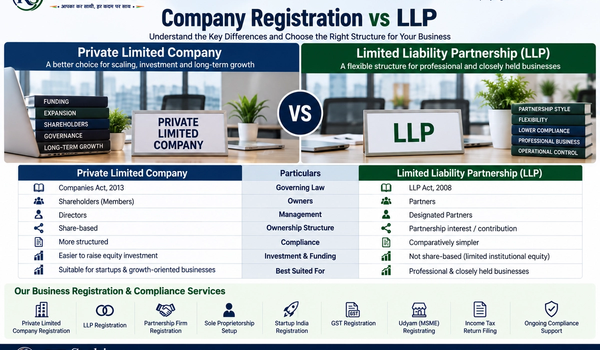
Company Registration vs LLP in India: Which Business Structure Should You Choose?
Choosing the right business structure is one of the first important decisions an entrepreneur has to make. A business may have a good product, reliable customers and enough capital
Startup India Registration: Complete Guide to DPIIT Recognition for Startups in India
Starting a new business is exciting, but turning an idea into a properly structured and recognized startup takes more than just registering a company. New founders often hear terms