GST Return Filing: A Complete Guide for Businesses in India
Running a business comes with several responsibilities, and filing GST returns is one of the most important among them. Every registered business is expected to report its sales.
Running a business comes with several responsibilities, and filing GST returns is one of the most important among them. Every registered business is expected to report its sales, purchases, tax collected, and tax paid to the government within the prescribed time. Filing returns regularly not only keeps your business compliant but also helps you avoid penalties and maintain a smooth flow of input tax credit.
Many business owners think GST Return Filing is complicated, but with the right understanding and proper records, the process becomes much easier. Whether you're a small trader, service provider, manufacturer, or e-commerce seller, this guide will help you understand GST Return Filing in simple words.
Particular
Details
WHY CLIENTS CHOOSE KAR SATHI
✓ Tax Experts✓ Maximum Refund Assistance✓ Notice Support✓ Secure Documents✓ Transparent Pricing✓ Fast Turnaround
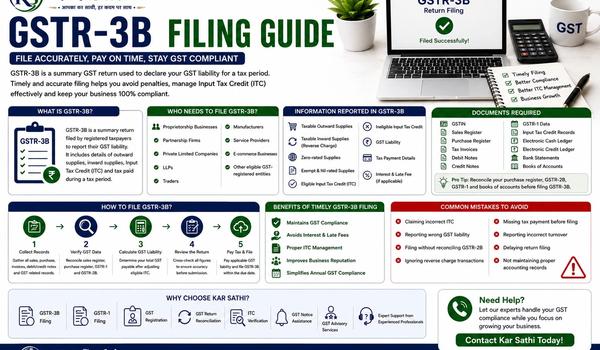
GSTR-3B Filing Guide: Everything You Need to Know About Filing GSTR-3B
For every GST-registered business, timely return filing is essential to stay compliant and avoid unnecessary penalties. Among the various GST returns, GSTR-3B is one of the most.
Kar Sathi is an independent private platform and is not affiliated with, endorsed by, sponsored by, or authorized by any government entity. Government-related information provided by Kar Sathi is for informational purposes only. Users should verify information with the relevant official government source.
Official government source links
Use these official websites to verify current information:
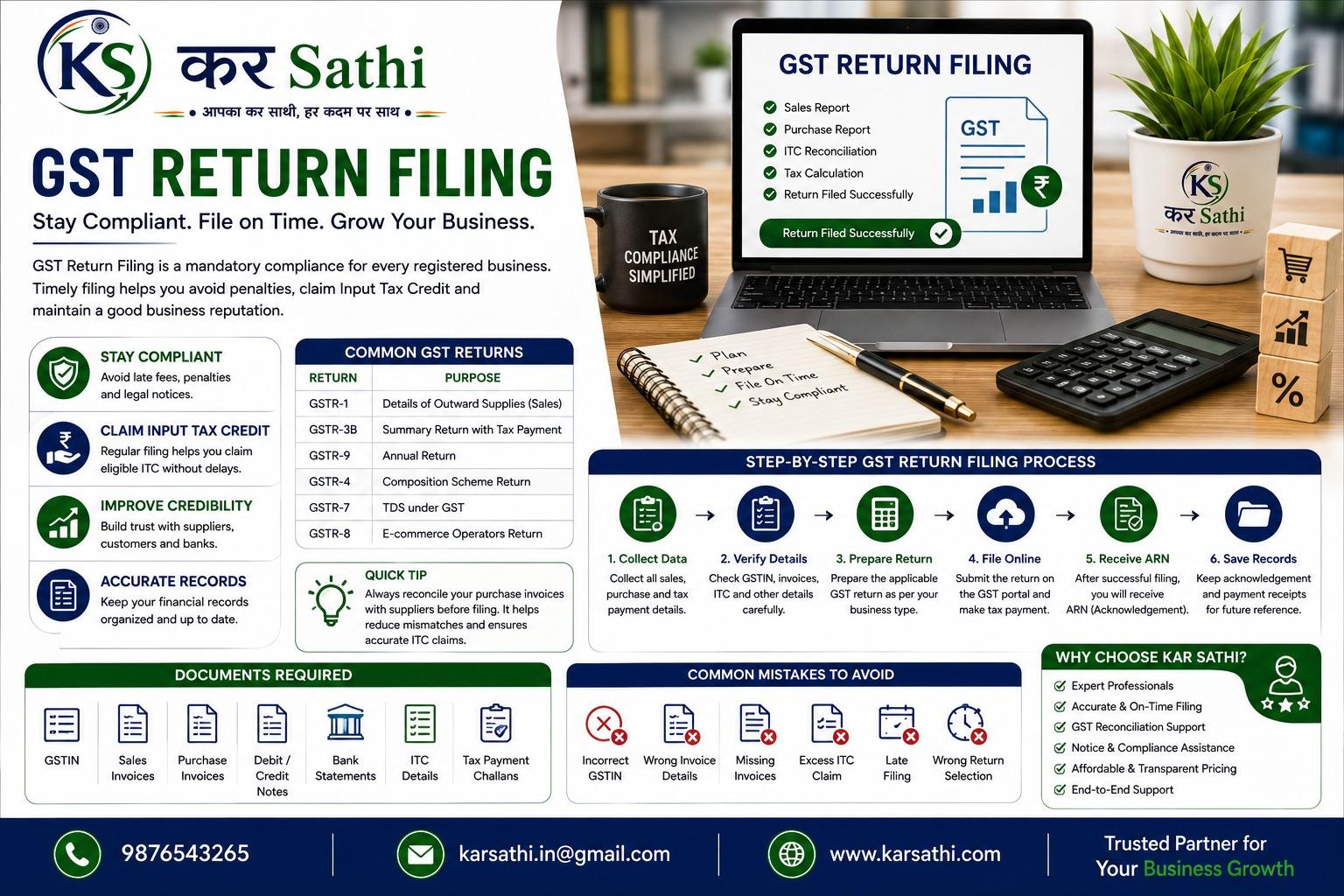
A GST Return is a document submitted by every registered taxpayer to the GST Department. It contains details of sales, purchases, output tax collected, and input tax credit claimed during a particular period.
The government uses this information to calculate the tax liability of a business and verify whether the correct amount of GST has been paid.
Timely filing of GST returns is essential even if there is no business transaction during a particular period. In such cases, eligible businesses may still need to file a Nil Return.
Why is GST Return Filing Important?
GST Return Filing is more than just a legal requirement. It helps maintain transparency and ensures that your business remains compliant with tax laws.
Some of the major benefits include
Maintains legal compliance
Avoids late fees and penalties
Helps claim Input Tax Credit (ITC)
Improves business credibility
Prevents notices from the GST Department
Keeps financial records updated
Makes business loans and audits easier
Regular filing also creates confidence among suppliers, customers, and financial institutions.
Who Needs to File GST Returns?
GST Return Filing is mandatory for businesses registered under GST.
This includes
Sole Proprietorships
Partnership Firms
LLPs
Private Limited Companies
Public Limited Companies
Manufacturers
Traders
Service Providers
E-commerce Sellers
Freelancers registered under GST
Input Service Distributors
Casual Taxable Persons
If your business has a valid GSTIN, you should file the applicable GST returns within the due dates.
Common Types of GST Returns
Different taxpayers are required to file different GST returns depending on the nature of their business.
Return
Purpose
GSTR-1
Details of Outward Supplies (Sales)
GSTR-3B
Summary Return with Tax Payment
GSTR-9
Annual Return
GSTR-4
Composition Scheme Return
GSTR-7
TDS under GST
GSTR-8
E-commerce Operators
Choosing the correct return and filing it on time is essential for proper compliance.
Documents Required
Before filing your GST Return, keep these details ready
GSTIN
Sales Invoices
Purchase Invoices
Debit & Credit Notes
Bank Statements
Input Tax Credit Details
Tax Payment Challans
Previous GST Returns (if applicable)
Step-by-Step GST Return Filing Process
Step 1: Collect Business Records
Gather all sales invoices, purchase invoices, and other relevant documents for the return period.
Step 2: Verify GST Details
Check GSTIN numbers, invoice values, tax amounts, and HSN/SAC details for accuracy.
Step 3: Prepare the Return
Prepare the applicable GST Return based on your business category and filing requirement.
Step 4: Review the Information
Cross-check all entries carefully to avoid errors or mismatches.
Step 5: Submit the Return
File the GST Return online through the GST portal and complete the tax payment, if applicable.
Step 6: Save the Acknowledgement
Keep a copy of the filing acknowledgement and payment receipt for future reference.
Benefits of Filing GST Returns on Time
Timely filing provides several long-term advantages.
Avoid Penalties
Late filing attracts additional fees and interest. Filing on time helps avoid unnecessary expenses.
Smooth Input Tax Credit
Regular filing allows businesses to claim eligible Input Tax Credit without delays.
Better Financial Management
Updated GST records make accounting and financial planning much easier.
Strong Business Reputation
Suppliers and customers prefer dealing with businesses that regularly comply with tax regulations.
Easy Loan Processing
Banks and financial institutions often review tax compliance while processing business loans.
Common Mistakes to Avoid
Many businesses receive notices due to avoidable mistakes.
Some common errors include
Incorrect GSTIN details
Wrong invoice information
Missing purchase invoices
Claiming excess Input Tax Credit
Filing incorrect GST return
Delayed filing
Ignoring reconciliation before submission
Taking a little extra time to review your records can save significant time and money later.
Why Choose Kar Sathi?
At Kar Sathi, we help businesses complete their GST Return Filing accurately and on time.
Our services include
Monthly GST Return Filing
Quarterly GST Return Filing
Annual Return Filing
GST Reconciliation
Input Tax Credit Verification
GST Notice Assistance
GST Compliance Support
Expert Consultation
Our experienced team ensures that your returns are prepared carefully, filed within the due dates, and fully compliant with GST regulations.
Conclusion
GST Return Filing is an essential responsibility for every registered business. Regular and accurate filing not only keeps your business compliant but also helps you claim Input Tax Credit, avoid penalties, and maintain a strong financial record.
Whether you run a small shop, a service business, or a growing company, timely GST compliance supports long-term business growth. With Kar Sathi, you receive reliable guidance and end-to-end support, making GST Return Filing simple, accurate, and completely hassle-free.
Frequently Asked Questions (FAQs)
1. Is GST Return Filing mandatory?
Yes. Every registered GST taxpayer must file the applicable GST returns within the prescribed due dates.
2. Can I file a GST Return if there are no transactions?
Yes. Eligible taxpayers may need to file a Nil GST Return even if no business transactions occurred during the return period.
3. What happens if I file my GST Return late?
Late filing may result in late fees, interest, and compliance issues under GST law.
4. Can a GST Return be revised after filing?
GST returns generally cannot be revised after submission. Any corrections are usually made in subsequent returns as permitted under GST provisions.
5. Why should I choose Kar Sathi for GST Return Filing?
Kar Sathi provides complete assistance with GST return preparation, reconciliation, timely filing, compliance support, and expert guidance, helping your business stay compliant without unnecessary stress.
COMMON QUESTIONS
Answers before you file.
Running a business comes with several responsibilities, and filing GST returns is one of the most important among them. Every registered business is expected to report its sales, purchases, tax collected, and tax paid to the government.
Tax & Compliance
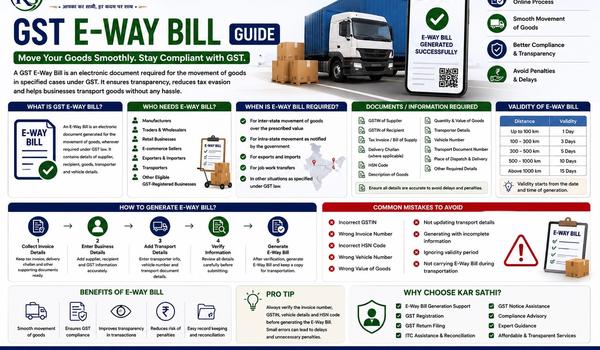
GST E-Way Bill Guide: Everything You Need to Know About E-Way Bills Under GST
Transporting goods is an essential part of running a business, but it also comes with compliance requirements under the Goods and Services Tax (GST) law. One of the most important.
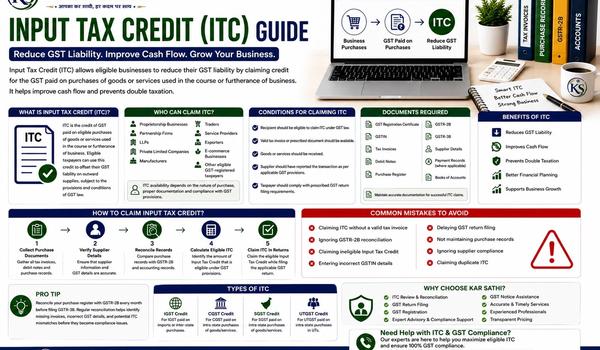
Input Tax Credit (ITC) Guide: Everything You Need to Know About Claiming GST Input Tax Credit
For every GST-registered business, managing taxes efficiently is just as important as generating sales. One of the biggest advantages of the GST system is Input Tax Credit (ITC).