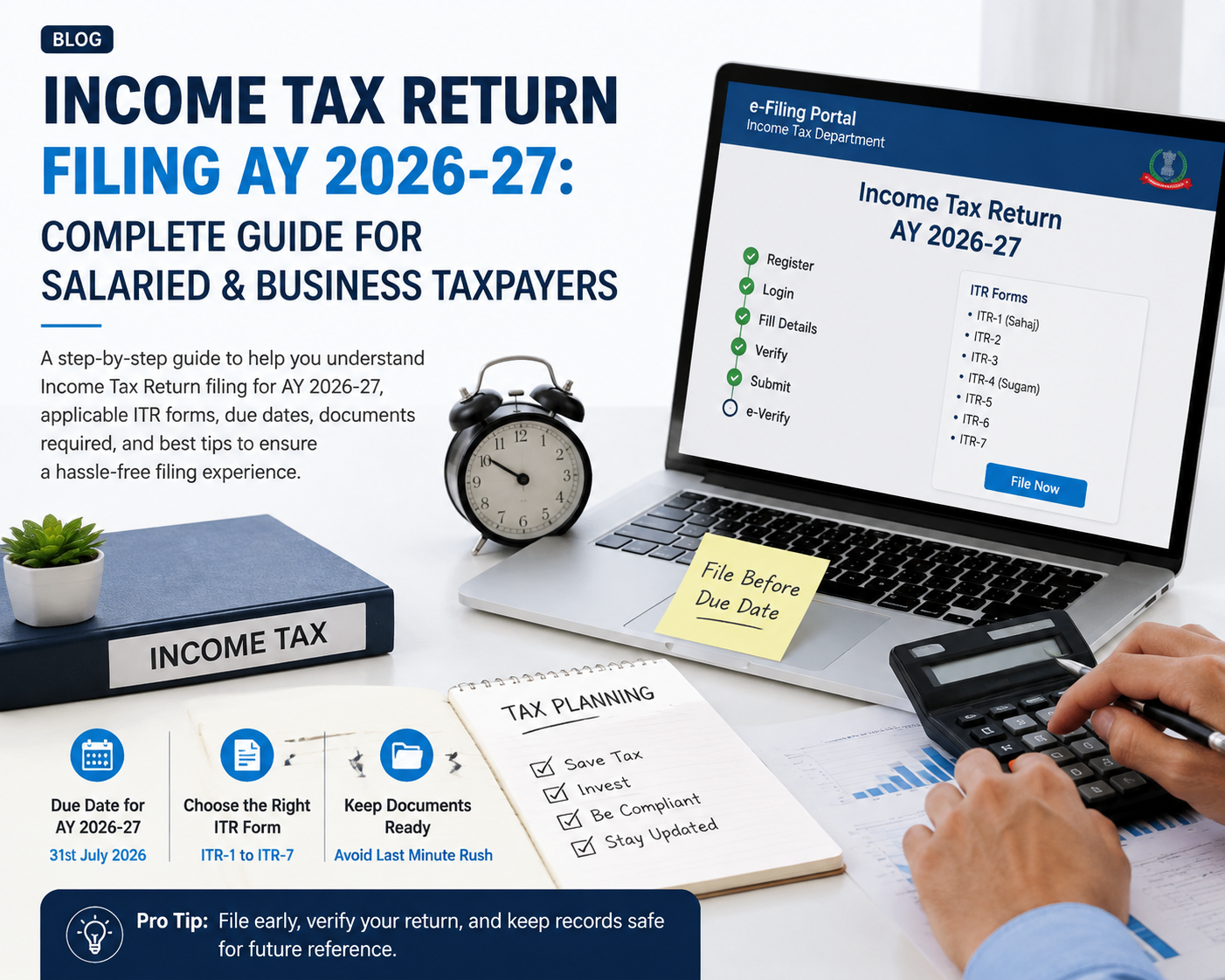
Income Tax Return Filing AY 2026-27: Complete Guide for Salaried & Business Taxpayers
Learn how to file Income Tax Return AY 2026-27 with eligibility, ITR forms, required documents, filing steps, due dates, tax-saving tips, and common mistakes.
Filing your Income Tax Return (ITR) is more than just a legal obligation—it's an essential part of managing your finances responsibly. Whether you're a salaried employee, a freelancer, a self-employed professional, or a business owner, filing your return on time helps you stay compliant with tax laws, claim eligible tax benefits, and build a strong financial record.
If you're planning to file your Income Tax Return for AY 2026-27, this guide will walk you through everything you need to know, including eligibility, required documents, different ITR forms, the filing process, common mistakes to avoid, and the benefits of filing your return on time.
What Is an Income Tax Return (ITR)?
An Income Tax Return (ITR) is a form submitted to the Income Tax Department that contains details of your income, taxes paid, deductions claimed, exemptions, and tax liability for a financial year.
WHY CLIENTS CHOOSE KAR SATHI
✓ Tax Experts✓ Maximum Refund Assistance✓ Notice Support✓ Secure Documents✓ Transparent Pricing✓ Fast Turnaround
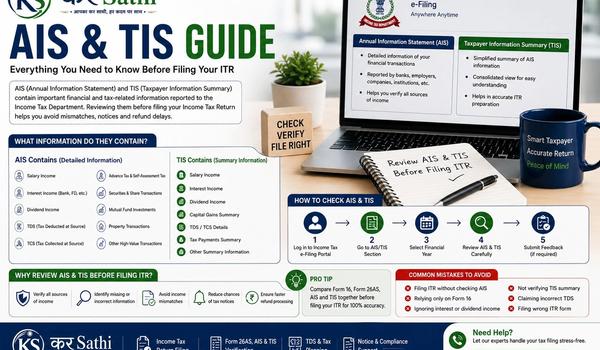
AIS & TIS Guide: Everything You Need to Know Before Filing Your Income Tax Return
Filing your Income Tax Return (ITR) is much easier when your income details are complete and accurate. While many taxpayers rely only on Form 16 or Form 26AS, the Income Tax.
Kar Sathi is an independent private platform and is not affiliated with, endorsed by, sponsored by, or authorized by any government entity. Government-related information provided by Kar Sathi is for informational purposes only. Users should verify information with the relevant official government source.
Official government source links
Use these official websites to verify current information:
For Assessment Year (AY) 2026-27, taxpayers will report the income earned during Financial Year (FY) 2025-26.
Filing an accurate return not only fulfills your legal responsibility but also helps in claiming refunds, maintaining financial transparency, and avoiding future tax-related issues.
Who Should File an Income Tax Return?
Many people believe that only those who have to pay income tax need to file an ITR. However, that's not always the case.
You should file an Income Tax Return if you are:
A salaried employee
A business owner or entrepreneur
A freelancer or consultant
A self-employed professional such as a doctor, lawyer, architect, or chartered accountant
A partner in a partnership firm
An individual earning capital gains from shares, mutual funds, or property
A person with foreign assets or overseas income
A company, LLP, trust, or other eligible entity
Anyone who meets the income tax filing requirements prescribed under the Income-tax Act
Even if your income is below the taxable limit, filing an ITR can be beneficial. It serves as proof of income, simplifies loan approvals, supports visa applications, and helps claim tax refunds whenever applicable.
Documents Required Before Filing Your ITR
Keeping your documents ready before you begin the filing process can save time and reduce the chances of errors.
Here are the documents you'll typically need:
PAN Card
Aadhaar Card
Form 16 (for salaried employees)
Salary slips
Bank account statements
Form 26AS
Annual Information Statement (AIS)
Taxpayer Information Summary (TIS)
Investment proofs for deductions
Home loan interest certificate (if applicable)
Capital gains statements
Rental income details (if applicable)
Business financial statements (for business owners and professionals)
Always verify the information in AIS and Form 26AS before filing your return to ensure that all income has been reported correctly.
Choosing the Right ITR Form
Selecting the correct ITR form is one of the most important steps while filing your return. Filing with the wrong form may lead to your return being treated as defective or require additional compliance later.
Below is a quick overview of all the ITR forms applicable for AY 2026-27.
ITR Form
Who Should File It?
ITR-1 (Sahaj)
Resident individuals with income from salary, one house property, and other sources (such as interest), subject to the prescribed eligibility conditions.
ITR-2
Individuals and Hindu Undivided Families (HUFs) who do not have business or professional income but have capital gains, multiple house properties, or foreign assets/income.
ITR-3
Individuals and HUFs earning income from a business or profession, including freelancers, consultants, doctors, lawyers, architects, and other professionals.
ITR-4 (Sugam)
Resident individuals, HUFs, and firms (other than LLPs) opting for the presumptive taxation scheme, subject to the applicable eligibility conditions.
ITR-5
Partnership firms, Limited Liability Partnerships (LLPs), Associations of Persons (AOPs), Bodies of Individuals (BOIs), cooperative societies, estates, and other eligible entities.
ITR-6
Companies that are not claiming exemption under Section 11 of the Income-tax Act.
ITR-7
Trusts, charitable and religious institutions, political parties, educational institutions, research associations, and other entities required to file returns under specific provisions of the Income-tax Act.
If you're uncertain about which form applies to your situation, consulting a qualified tax professional can help you avoid filing errors and delays.
How to File Income Tax Return AY 2026-27
The online filing process has become much simpler over the years. Following these steps can help ensure a smooth filing experience.
Step 1: Gather Your Documents
Keep all your financial documents, including Form 16, AIS, Form 26AS, PAN, Aadhaar, and investment proofs, ready before you begin.
Step 2: Choose the Correct ITR Form
Select the form based on your source of income and taxpayer category.
Step 3: Verify Your Income
Cross-check your salary, business income, interest income, rental income, capital gains, and any other earnings with Form 26AS and AIS.
Step 4: Claim Eligible Deductions
Claim all deductions and exemptions for which you qualify under the applicable provisions of the Income-tax Act.
Step 5: Calculate Your Tax Liability
Review your tax calculation carefully to determine whether you need to pay additional tax or are eligible for a refund.
Step 6: Submit Your Return
Complete and submit your Income Tax Return through the Income Tax Department's e-filing portal.
Step 7: Verify Your Return
After submission, complete the e-verification process using Aadhaar OTP, net banking, digital signature, or any other available verification method.
Remember, your ITR filing is considered complete only after successful verification.
Benefits of Filing Your Income Tax Return on Time
Timely filing offers several financial and legal advantages.
Some of the key benefits include:
Faster processing of income tax refunds
Avoidance of late filing fees and penalties
Better chances of loan and credit card approval
Smooth visa application process
Ability to carry forward eligible business or capital losses
Strong financial documentation
Reduced chances of receiving compliance notices
Filing early also gives you enough time to correct any mistakes before the deadline.
Common Mistakes to Avoid While Filing ITR
Even a small error can delay your refund or result in notices from the Income Tax Department.
Before submitting your return, make sure you have not:
Selected the wrong ITR form
Entered incorrect PAN or bank account details
Missed reporting interest income or capital gains
Claimed deductions without supporting documents
Ignored mismatches in AIS or Form 26AS
Forgotten to e-verify your return
Reported incorrect personal information
Reviewing your return thoroughly before submission can save you from unnecessary complications later.
Final Thoughts
Filing your Income Tax Return AY 2026-27 doesn't have to be complicated. With the right documents, accurate information, and a clear understanding of the filing process, you can complete your return confidently and on time.
Whether you're a salaried employee, freelancer, business owner, or company representative, choosing the correct ITR form and reporting your income accurately are the most important steps toward hassle-free tax compliance.
If your tax situation involves business income, multiple investments, foreign assets, or complex transactions, seeking professional advice can help ensure accuracy and maximize your eligible tax benefits.
A timely and correctly filed Income Tax Return not only keeps you compliant with tax laws but also strengthens your financial credibility for years to come.
Thanks Kar Sathi
COMMON QUESTIONS
Answers before you file.
Assessment Year 2026-27 is the year in which income earned during Financial Year 2025-26 is assessed for income tax purposes.
Tax & Compliance
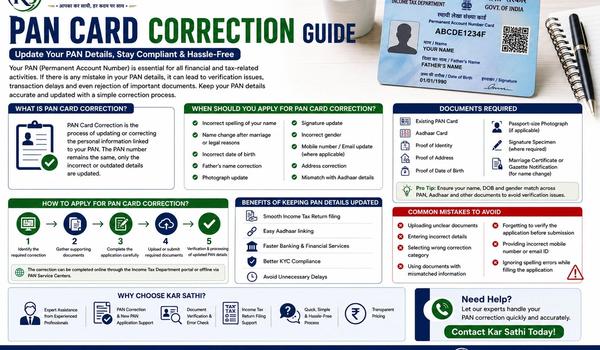
PAN Card Correction Guide: How to Update Your PAN Details Easily
Your PAN (Permanent Account Number) is one of the most important identity documents for financial and tax-related activities in India. Whether you're filing your Income Tax Return.
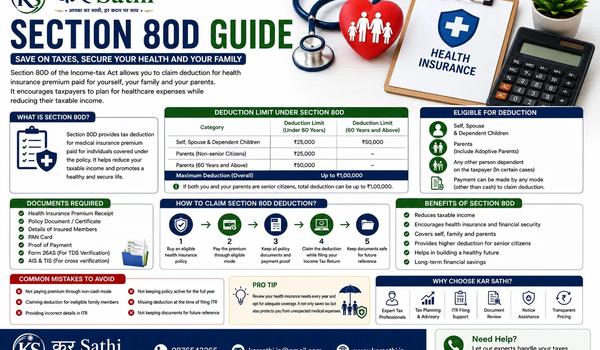
Section 80D Guide: How Health Insurance Can Help You Save Income Tax
Buying health insurance is one of the smartest financial decisions you can make. It protects you and your family from unexpected medical expenses while also offering valuable tax.