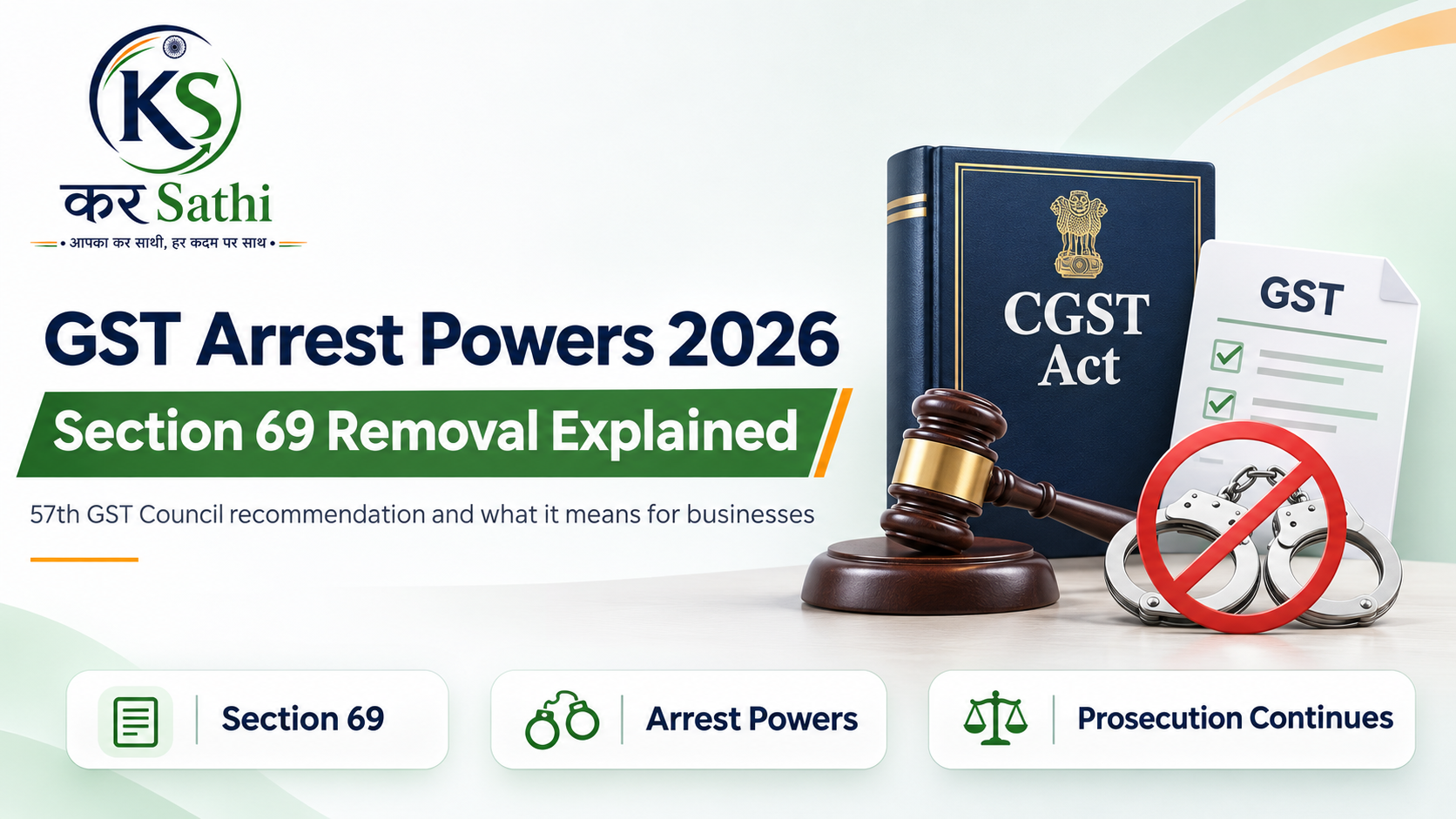
GST Arrest Powers 2026: What Removal of Section 69 Means for Taxpayers
The 57th GST Council recommended omitting Section 69. Learn how the proposal differs from the existing arrest law and why legal implementation must be verified.
Published 2 November 2026Last Updated 2 November 20268 min readBy Kar Sathi Team
Updated: 2 November 2026 | Category: GST Updates & Compliance
For many business owners, receiving a GST notice is manageable. What creates far greater concern is the possibility of personal arrest during a tax investigation, particularly where the business believes the issue is a genuine compliance dispute rather than deliberate fraud.
The 57th GST Council Meeting held on 8 October 2026 recommended a major change: complete withdrawal of GST arrest powers by omitting Section 69 of the CGST Act, 2017. The recommendation is one of the most significant enforcement reforms proposed under GST since its introduction.
The Council recommendation does not itself repeal Section 69. Proposed changes are not effective unless the necessary legislation and commencement provisions take legal effect.
The 57th GST Council proposed a ₹5 crore prosecution threshold and changes to arrest powers. These recommendations require legal implementation before taking effect.
KAR SATHI
Need help with a GST notice or compliance issue?
Contact Kar Sathi for professional assistance with GST notices, ITC reconciliation and compliance.
Kar Sathi is an independent private platform and is not affiliated with, endorsed by, sponsored by, or authorized by any government entity. Government-related information provided by Kar Sathi is for informational purposes only. Users should verify information with the relevant official government source.
State-specific instructions should also be checked
Final Legal Change
Requires legislative amendment and commencement
What Does Section 69 of the CGST Act Currently Provide?
Section 69 is the provision that gives the Commissioner power to authorise arrest in specified GST cases.
Under the existing statutory wording, the Commissioner must have reasons to believe that a person has committed specified offences under Section 132 and that the conditions for arrest under the provision are satisfied.
The law does not provide a general power to arrest someone merely because
A GST notice has been issued
Tax is unpaid
There is a reconciliation mismatch
GSTR-2B does not match the books
A departmental inquiry has started
The power is linked to specified offences and statutory conditions.
CBIC's own 17 August 2022 arrest guidelines also emphasised that an arrest should not be routine merely because the legal power exists. The guidelines refer to factors such as the seriousness of the offence, need for custodial investigation, risk of absconding and possibility of influencing witnesses.
What Did the 57th GST Council Recommend?
The official recommendation is clear.
The GST Council proposed complete withdrawal of arrest powers under GST by omitting Section 69 of the CGST Act, 2017.
The Council also proposed related prosecution reforms, including
Increasing the prosecution threshold from ₹1 crore to ₹5 crore
Narrowing certain offences under Section 132
Rationalising punishment for GST offences
Restricting criminal provisions more closely to serious fraud and evasion
The overall direction is toward reducing criminal enforcement in ordinary compliance disputes while retaining action against serious tax fraud.
Has the recommendation changed the law?
No. The recommended omission is subject to legislative implementation. It must not be described as an effective repeal merely because the Council recommended it.
Does Removal of Arrest Power Mean GST Prosecution Is Also Removed?
No.
Arrest and prosecution are different legal concepts.
Arrest involves taking a person into custody under legal authority.
Prosecution involves criminal proceedings before a competent court for an alleged offence.
The Council has recommended removing the GST-specific arrest power under Section 69, but it has not recommended eliminating all criminal offences under Section 132.
Serious allegations involving fake invoicing or fraudulent ITC must be assessed against the applicable Section 132 offences. The proposed reforms do not make fraudulent transactions lawful.
This distinction is particularly important for directors, proprietors and other persons involved in GST investigations.
Practical Example
Suppose a company receives a GST notice alleging wrongful ITC of ₹2 crore because several supplier invoices are disputed.
If the company can show that goods were actually received, payments were made, transport records exist and the issue relates to reporting or reconciliation, the factual situation is very different from a case involving fake invoices without any underlying supply.
The mere existence of a large GST dispute should not automatically be equated with criminal fraud.
Even after the proposed arrest reforms, however, the department can still investigate the transactions, determine tax liability and recover applicable tax, interest or penalties where legally justified.
Quick Tip: Keep invoices, bank payment records, purchase orders, goods-receipt records, e-way bills and GSTR-2B reconciliation working papers organised. Documentation becomes especially important when the department questions whether a transaction was genuine.
Why Were GST Arrest Powers Controversial?
The power of arrest carries consequences beyond tax recovery.
An arrest can affect personal liberty, reputation and business operations even before a court finally determines whether the alleged offence is proved.
CBIC's 2022 guidelines themselves recognised that the existence of a lawful power to arrest does not mean arrest must automatically follow in every investigation.
The 57th GST Council's recommendation takes that approach significantly further by proposing removal of Section 69 itself.
If enacted, investigation and prosecution would still remain available in appropriate cases, but GST officers would no longer use the specific arrest power contained in Section 69.
What Happens to Existing Investigations and Arrest Cases?
The recommendation does not automatically cancel
GST investigations
Tax demands
Interest liabilities
Civil penalties
Existing prosecution proceedings
Earlier arrests or bail proceedings
An existing matter must be reviewed according to its own stage and facts.
Where a person has already been arrested or criminal proceedings have already started, the effect of future amendments will depend on the final legislation, commencement provisions and applicable judicial principles.
Businesses should therefore avoid assuming that a pending case has ended merely because the Council has recommended removal of arrest powers.
What Should Businesses Do Now?
Businesses under investigation should continue treating GST proceedings seriously.
They should
Respond to summons and notices within applicable timelines
Maintain accurate GSTR-1 and GSTR-3B records
Reconcile ITC with GSTR-2B
Preserve genuine purchase and payment documentation
Avoid unsupported invoices or accommodation entries
Record movement and receipt of goods properly
Review serious allegations with an experienced GST or legal professional
Check the enacted provisions and applicable official notifications before relying on a proposed change in any investigation.
Why This Change Matters for Businesses
The proposed omission of Section 69 represents a major shift in GST enforcement philosophy.
Instead of using GST-specific arrest powers during investigations, the proposed framework places greater emphasis on tax recovery, adjudication and prosecution through the judicial process in serious cases.
For genuine businesses, this may reduce the fear that an ordinary GST dispute could quickly escalate into personal custody.
The proposal does not legalise fake invoices, fraudulent ITC or deliberate evasion. Existing legal duties continue unless changed through the applicable legal process.
Conclusion
The 57th GST Council Meeting 2026 has recommended complete withdrawal of GST arrest powers through omission of Section 69 of the CGST Act.
The proposed omission of Section 69 remains subject to legislative implementation. A Council recommendation alone does not establish that GST arrests have stopped.
For businesses, the safest approach remains straightforward: maintain genuine records, respond properly to investigations and distinguish an ordinary tax dispute from allegations involving criminal fraud.
Why Choose Kar Sathi?
Kar Sathi assists businesses with GST registration, return filing, ITC reconciliation, GST compliance reviews and documentation relating to departmental notices.
If your business is facing a GST investigation or notice, the first step should be to understand the exact allegation, identify the applicable provision and review the supporting records before responding.
Need help with a GST notice or investigation? Contact Kar Sathi for professional assistance.
Readers may also explore Kar Sathi's related guides on GST Prosecution Rules 2026, Input Tax Credit, GSTR-3B Filing and GST Notice Compliance.
Not yet. The 57th GST Council recommended complete withdrawal of GST arrest powers by omitting Section 69, but the statutory amendment must become legally effective before Section 69 is treated as repealed.
Understand the 57th GST Council’s proposed ₹10,000 notice threshold, Section 125 penalty reduction, non-fraud relief and new safeguards for e-way bill enforcement.