GST Notice and Penalty Changes 2026: ₹10,000 Threshold, Section 125 and E-Way Bill Relief
Understand the 57th GST Council’s proposed ₹10,000 notice threshold, Section 125 penalty reduction, non-fraud relief and new safeguards for e-way bill enforcement.
Published 2 November 2026Last Updated 2 November 20269 min readBy Kar Sathi Team
Updated: 2 November 2026 | Category: GST Updates & Compliance
A GST dispute does not always involve crores of rupees. Many businesses spend considerable time responding to notices involving relatively small tax differences, procedural mistakes or minor compliance issues.
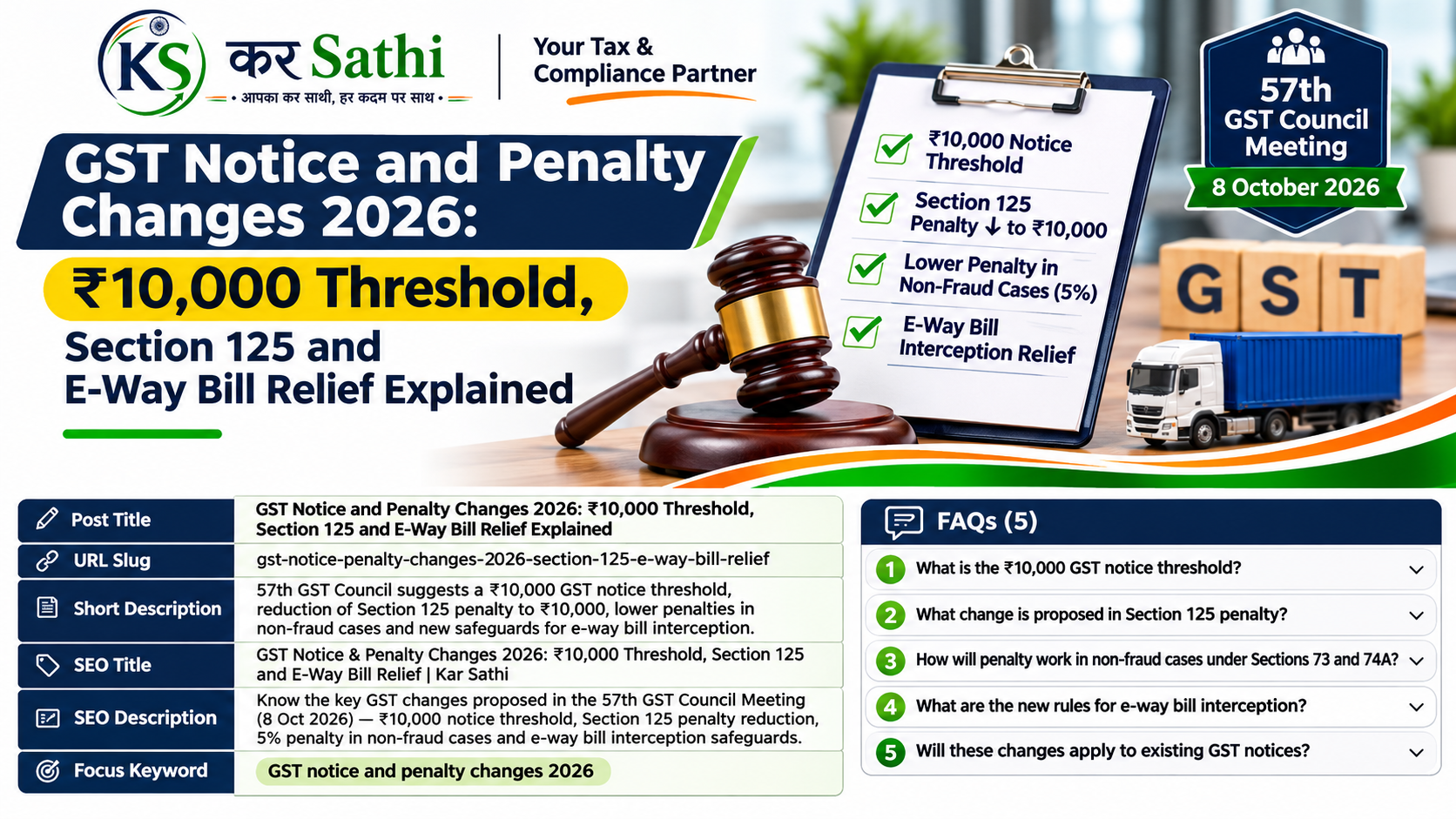
The 57th GST Council Meeting held on 8 October 2026 recommended several reforms aimed at reducing this burden. These include a ₹10,000 minimum threshold for specified GST show-cause notices, reduction of the general penalty under Section 125, lower penalties in certain non-fraud cases and tighter safeguards around interception of goods in transit.
For small and medium businesses, these changes could make routine GST enforcement more proportionate. However, most of these measures require legislative amendments before they can be treated as fully operative law.
The 57th GST Council recommended omitting Section 69. Learn how the proposal differs from the existing arrest law and why legal implementation must be verified.
KAR SATHI
Need help with a GST notice or compliance issue?
Contact Kar Sathi for professional assistance with GST notices, ITC reconciliation and compliance.
Kar Sathi is an independent private platform and is not affiliated with, endorsed by, sponsored by, or authorized by any government entity. Government-related information provided by Kar Sathi is for informational purposes only. Users should verify information with the relevant official government source.
Maximum proposed to reduce from ₹25,000 to ₹10,000
Non-Fraud Penalty
5% in specified cases on timely payment
Section 73 Payment Period
Within 30 days of adjudication order
Section 74A Payment Period
Within 60 days of adjudication order
Minimum ₹10,000 Penalty
Proposed removal in non-fraud cases
E-Way Bill Interception
Specific intelligence + senior officer authorisation proposed
Transit-State Interception
Proposed restrictions
Legal Status
Recommendations subject to implementation
Important: A ₹10,000 notice threshold does not mean tax below ₹10,000 is automatically waived. It concerns issuance of specified show-cause notices under the proposed framework.
₹10,000 Minimum Threshold for GST Show-Cause Notices
One of the most practical recommendations concerns small-value GST disputes.
The Council recommended amendments to Sections 73, 74 and 74A so that a show-cause notice would generally not be issued where the total tax amount involved is less than ₹10,000.
For this purpose, the ₹10,000 amount is proposed to be calculated by combining
CGST
SGST or UTGST
IGST
Compensation Cess, where applicable
The official Council release also recommends a statutory mechanism for notices and appeals involving amounts below ₹10,000 that are already pending when the new threshold comes into force.
Practical Example
Suppose a business has a proposed GST difference of ₹7,500.
Under the recommended framework, a show-cause notice under the specified provisions would generally not be issued solely for that tax amount.
But this should not be interpreted as a blanket ₹7,500 tax waiver. The legal treatment of the underlying liability will depend on the final amendment and applicable procedure.
That distinction is important because a notice threshold and a tax exemption are two very different things.
Section 125 General Penalty Proposed to Reduce to ₹10,000
Section 125 of the CGST Act deals with a general penalty where a person contravenes GST provisions but no separate penalty is specifically provided for that contravention.
The current maximum general penalty is ₹25,000.
The 57th GST Council recommended reducing this maximum to ₹10,000.
For businesses, this could reduce the financial impact of certain procedural or residual compliance failures.
However, Section 125 should not be confused with penalties specifically prescribed for offences such as fraud, wrongful ITC, failure to issue invoices or other particular contraventions.
If another section specifically provides a penalty, that provision may continue to apply.
Lower Penalty Proposed in Certain Non-Fraud Cases
The Council has also recommended relief where a taxpayer pays the determined tax and interest within the prescribed period after an adjudication order.
Under the proposed changes, a 5% penalty would apply in specified non-fraud cases where payment is made:
Within 30 days of the adjudication order under Section 73
Within 60 days of the adjudication order under Section 74A
The Council also recommended removing the existing minimum ₹10,000 penalty requirement in non-fraud cases.
This could matter particularly where the tax amount involved is small.
For example, applying a fixed minimum penalty to a relatively minor tax difference can sometimes produce a penalty that looks disproportionate to the amount actually disputed.
The proposed reform appears intended to address that issue.
Fraud and Non-Fraud Cases Should Not Be Treated the Same
One of the broader themes of the 57th GST Council recommendations is greater distinction between genuine compliance issues and deliberate misconduct.
A business that made an accounting error or interpreted a provision differently is not automatically in the same position as a taxpayer who created fake invoices or deliberately concealed transactions.
This does not mean every mistake will be penalty-free.
Instead, the nature of the case should determine which statutory provision applies and what consequences follow.
Good documentation remains especially important where a taxpayer wants to show that an issue arose from reconciliation, interpretation or an operational error rather than fraudulent conduct.
Major Changes Proposed for E-Way Bill Enforcement
The 57th GST Council has also recommended substantial changes to the way goods and vehicles are intercepted during transit.
The Council proposed amendments to Sections 68, 129 and 130 of the CGST Act.
Under the recommended framework, a conveyance carrying goods could be intercepted only where there is specific intelligence and authorisation from an officer not below the rank of Joint Commissioner.
This is intended to reduce routine or unnecessary interception of genuine business consignments.
No Routine Interception in Transit States
Another important recommendation concerns goods moving through multiple states.
The Council proposed that inspection and detention action should generally be taken where either the supplier or recipient is located or registered in the State where the interception takes place.
In other words, routine interception in a State through which the goods are merely passing is proposed to be restricted.
There is, however, an important exception.
Where
No e-way bill has been generated, or
The vehicle does not carry documents showing the origin or destination of the goods,
inspection, detention or seizure may still be possible irrespective of jurisdiction under the proposed framework.
So businesses should not interpret the proposed safeguards as permission to move goods without proper GST documentation.
Proposed Relief From Confiscation During Transit
The Council further recommended that Section 130 confiscation provisions should not apply to goods or conveyances in transit.
The stated objective is smoother movement of goods and improved transportation efficiency.
This is potentially important for businesses whose supply chains depend on regular interstate movement.
Unnecessary detention of a vehicle can cause consequences beyond GST itself—delivery delays, customer issues, storage costs and disruption to production schedules.
Practical Example: Goods Moving Across Three States
Suppose a manufacturer in Punjab sends goods to a customer in Maharashtra and the truck passes through another State on the way.
The invoice and valid e-way bill are available, and neither the supplier nor recipient is registered in the transit State.
Under the recommended framework, routine interception in that transit State would be restricted.
This does not mean the vehicle can never be checked. If required documents are absent or there is legally relevant specific intelligence, enforcement action may still arise according to the final provisions.
The purpose is to reduce unnecessary interruption of genuine trade—not to remove e-way bill compliance.
What Should Businesses Do Now?
These recommendations may reduce compliance burden, but businesses should continue working on basic GST controls.
In practice, that means
Reconcile GST returns regularly
Respond to notices within the prescribed deadline
Check the exact section mentioned in every notice
Preserve invoices and payment records
Generate e-way bills wherever required
Ensure drivers carry the prescribed documents
Maintain proof of movement and delivery of goods
Review penalty calculations instead of accepting them automatically
Small-value disputes should also not be ignored simply because a ₹10,000 threshold has been recommended. Until the relevant amendment becomes effective, businesses need to follow the law currently in force.
Why Choose Kar Sathi?
A GST notice may appear simple because the amount involved is small, but the section mentioned in the notice can materially affect the response.
Kar Sathi assists businesses with GST return filing, reconciliations, notice-related documentation, e-way bill compliance and review of tax and penalty issues.
The aim is to first understand what the department is alleging, verify the records and then respond according to the applicable provision rather than treating every GST communication in the same way.
You may also read our related guides on GST Prosecution Rules 2026, GST Arrest Powers 2026, GST Prosecution Threshold 2026 and GST E-Way Bill Compliance.
Conclusion
The 57th GST Council Meeting 2026 proposed several reforms that could make routine GST enforcement more proportionate.
The ₹10,000 minimum notice threshold, reduction of the Section 125 general penalty, lower penalties in certain non-fraud cases and restrictions on routine e-way bill interception could reduce unnecessary compliance disputes for genuine businesses.
But the reforms should not be misunderstood as a relaxation of GST compliance itself.
Businesses still need accurate returns, proper invoices, valid e-way bills and supporting records. Until the recommended amendments become legally effective, taxpayers should continue following the provisions currently in force.
Need help with a GST notice, penalty or e-way bill issue? Contact Kar Sathi for professional assistance with reviewing the matter and identifying the appropriate next steps.
Official Government References
GST Council — Recommendations of the 57th Meeting, 8 October 2026 [Official 57th GST Council Press Release](https://gstcouncil.gov.in/sites/default/files/2026-10/press_release.pdf?utm_source=chatgpt.com)
GST Council — FAQs on Recommendations of the 57th Meeting [Official GST Council FAQs](https://gstcouncil.gov.in/faq?utm_source=chatgpt.com)
CBIC — E-Way Bill Rules and Verification Framework [Official CBIC E-Way Bill Rules](https://cbic-gst.gov.in/ewaybill-rules.html?utm_source=chatgpt.com)
Disclaimer: This article is for general information and reflects the GST Council recommendations available as of 2 November 2026. Recommendations require appropriate legislative or procedural implementation before they become operative law. The treatment of an individual case depends on the applicable law and facts. Kar Sathi is an independent private tax and compliance service provider and is not a government agency.
COMMON QUESTIONS
Answers before you file.
The 57th GST Council recommended that specified show-cause notices under Sections 73, 74 and 74A generally not be issued where the total tax involved is below ₹10,000, subject to final implementation.
The 57th GST Council proposed a ₹5 crore prosecution threshold and changes to arrest powers. These recommendations require legal implementation before taking effect.