Updated: 2 November 2026 | Category: GST Updates & Compliance
A GST demand running into crores can be worrying, but a large tax dispute does not automatically become a criminal prosecution case.
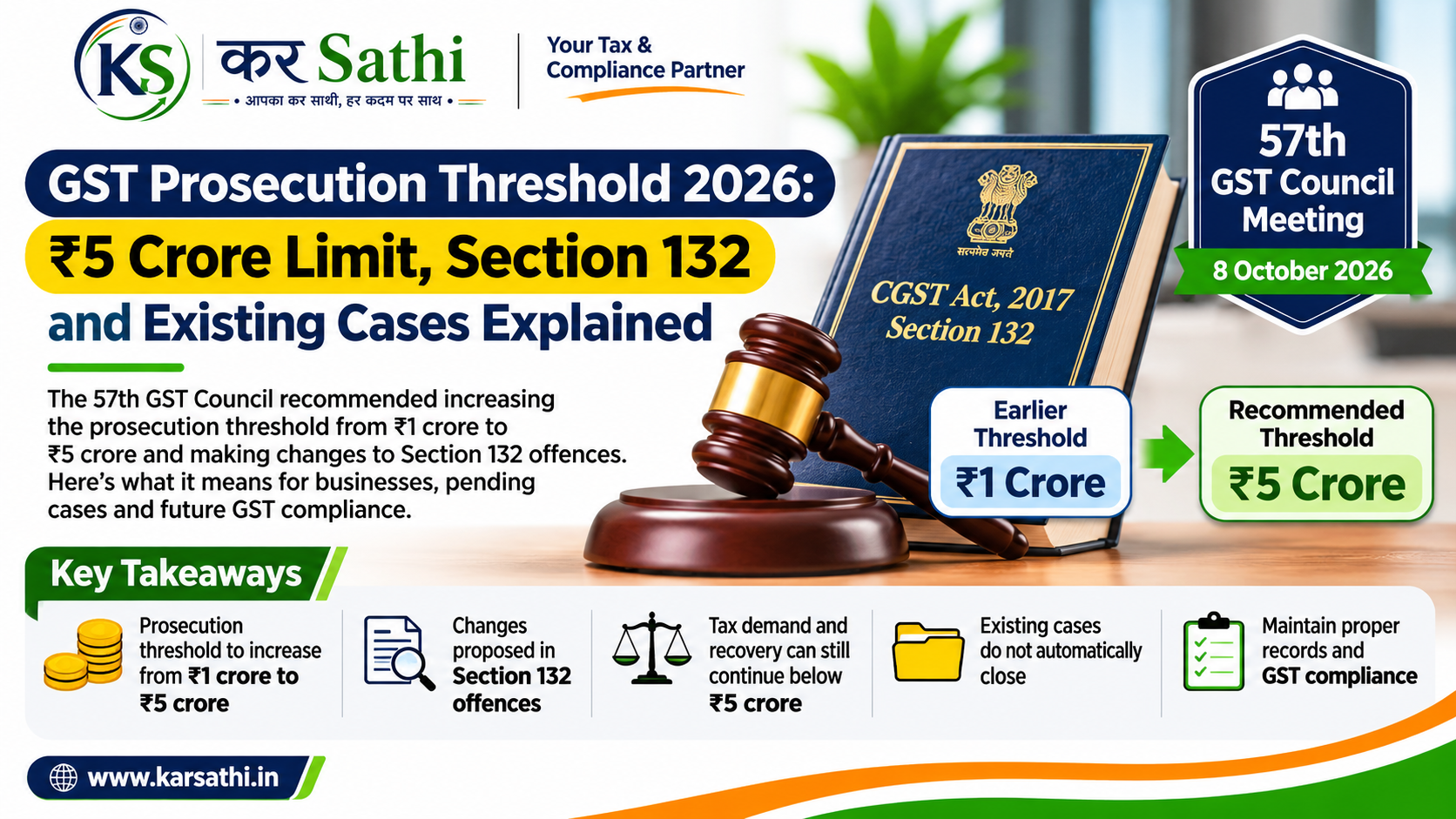
That distinction has become even more relevant after the 57th GST Council Meeting held on 8 October 2026, where the Council recommended increasing the GST prosecution threshold from ₹1 crore to ₹5 crore. It also proposed changes to Section 132 offences and the punishment framework.
For businesses already dealing with GST investigations, however, the ₹5 crore figure is only one part of the picture. The nature of the alleged offence, evidence, existing CBIC prosecution guidelines and the final legislative amendments all matter.
The 57th GST Council recommended omitting Section 69. Learn how the proposal differs from the existing arrest law and why legal implementation must be verified.
KAR SATHI
Need help with a GST notice or compliance issue?
Contact Kar Sathi for professional assistance with GST notices, ITC reconciliation and compliance.
Kar Sathi is an independent private platform and is not affiliated with, endorsed by, sponsored by, or authorized by any government entity. Government-related information provided by Kar Sathi is for informational purposes only. Users should verify information with the relevant official government source.
Important: The proposed ₹5 crore threshold relates to criminal prosecution. It is not a minimum limit for issuing a GST notice, demanding tax, charging interest or imposing a civil penalty.
What Does GST Prosecution Actually Mean?
GST prosecution is different from an ordinary tax demand.
A regular GST proceeding may result in tax, interest, penalty or recovery action. Prosecution is more serious because it involves an alleged criminal offence under Section 132 and can lead to proceedings before a criminal court.
Section 132 deals with specified offences such as fake invoicing, fraudulent input tax credit, fraudulent refunds, deliberate tax evasion and falsification or destruction of records.
This is why a simple return mismatch or disputed ITC claim should not automatically be treated as criminal fraud. The department has to look at what actually happened and whether the ingredients of the alleged offence are present.
What Is Changing From ₹1 Crore to ₹5 Crore?
Under the existing Section 132 structure, specified offences involving amounts above ₹1 crore can enter the statutory punishment framework.
The 57th GST Council has recommended increasing the prosecution threshold itself to ₹5 crore.
If the recommendation becomes law in the form proposed, comparatively smaller cases may remain outside the criminal prosecution framework even though tax recovery proceedings can still continue.
Take a simple example.
Suppose the department alleges that a company wrongly availed ₹3 crore of ITC. If the final amended law applies a ₹5 crore prosecution threshold to that offence, the case may fall below the revised prosecution limit.
That does not mean the ₹3 crore dispute disappears. The department can still examine the ITC, demand tax where legally payable, charge interest and impose applicable penalties.
So, the ₹5 crore figure alone does not decide whether a taxpayer has a GST liability.
But Didn't CBIC Already Have a ₹5 Crore Limit?
Yes. This is where many articles on the subject become confusing.
CBIC issued Instruction No. 04/2022-23 dated 1 September 2022 containing guidelines for launching prosecution under GST.
Those guidelines generally stated that prosecution should normally be launched where the amount of tax evasion, wrongful ITC or fraudulent refund exceeds ₹5 crore, subject to specified exceptions.
In other words, two things existed at the same time
The law: Section 132 contained punishment provisions starting above ₹1 crore for specified offences.
CBIC's administrative policy: prosecution was generally to be launched above ₹5 crore, subject to exceptions.
The 57th GST Council recommendation is important because it proposes changing the statutory threshold itself, rather than merely relying on an administrative guideline.
A Confirmed GST Demand Does Not Automatically Mean Prosecution
The 2022 CBIC guidelines also make an important practical point: prosecution should not be launched merely because a tax demand has been confirmed.
Officers are expected to consider the seriousness of the offence, available evidence, amount involved and whether fraudulent intent or knowledge can actually be established.
The guidelines also recognise that purely technical disputes or genuine differences in interpretation should not automatically be turned into criminal cases.
That matters because GST disputes can arise for many reasons.
A business may have genuine invoices and actual supplies but still face a disagreement over ITC eligibility, classification, valuation or reporting.
That situation is very different from creating invoices without any real supply or deliberately using fake transactions to claim credit.
Section 132 Offences Are Proposed to Be Narrowed
The Council has not only recommended a higher threshold. It has also proposed changes to the wording of certain offences under Section 132.
The recommendations include
Narrowing Section 132(1)(c) toward fraudulent ITC without actual receipt of goods or services, or without an invoice or bill
Omitting clause (i)
Removing the words relating to tax evasion from clause (e)
Narrowing some of the broader wording in clause (h)
These changes matter because the nature of the offence is just as important as the amount involved.
A ₹6 crore genuine commercial dispute is not automatically the same as a ₹6 crore fake-invoice operation. Facts, documents and intent still matter.
Practical Example
Suppose a manufacturer receives a notice alleging ₹3 crore of ineligible ITC.
The company has purchase invoices, bank payment records, e-way bills, stock entries and proof that goods were actually received.
The department may still dispute whether the ITC satisfies the legal conditions, and the business may still have to defend the claim.
But that factual situation is clearly different from a case where invoices were created without any underlying supply.
Good records do not guarantee that a GST dispute will never arise. They do, however, make it much easier to show what actually happened.
What Happens to Existing Cases Below ₹5 Crore?
This is especially important for taxpayers who already have a prosecution matter pending.
The GST Council recommendation does not automatically close existing cases.
Whether a pending case benefits from the proposed reform will depend on the final amendment, its effective date, the offence involved, the stage of proceedings and any transitional provisions.
So, a taxpayer facing a ₹2 crore or ₹3 crore prosecution case should not assume that the matter has ended.
The correct approach is to review the case once the final legislative text and commencement provisions are available.
What Should Businesses Do Now?
The proposed reform is encouraging, but it does not reduce the need for proper GST compliance.
Businesses should keep their GSTR-1, GSTR-3B and GSTR-2B reconciled, maintain genuine invoices and preserve proof of receipt of goods or services.
Payment records, e-way bills, purchase orders, stock records and supplier correspondence can become very important when the department questions a transaction.
High-value notices should also be reviewed early rather than being allowed to move from a tax dispute into a more serious enforcement matter.
Why Choose Kar Sathi?
A high-value GST dispute can involve several different issues at the same time—tax liability, ITC eligibility, penalties and, in serious cases, prosecution.
Kar Sathi assists businesses with GST compliance, return filing, ITC reconciliation, record review and documentation relating to departmental notices.
The first step in any serious GST matter should be to understand the exact allegation and supporting evidence instead of assuming that every large demand is automatically a criminal case.
You may also read our related guides on GST Arrest Powers 2026, GST Prosecution Rules 2026, Input Tax Credit and GST Notice Compliance.
Conclusion
The proposed ₹5 crore GST prosecution threshold is an important reform, but it needs to be understood correctly.
It does not mean that tax demands below ₹5 crore disappear, and it does not automatically close pending prosecution cases. What it may do, once legally implemented, is reduce the use of criminal prosecution in cases that fall below the revised statutory threshold.
For genuine businesses, the most practical protection remains the same: keep transactions real, records complete and GST filings properly reconciled.
Need help with a high-value GST notice or ITC dispute? Contact Kar Sathi for professional assistance with reviewing your records and identifying the appropriate next steps.
The 57th GST Council recommended increasing the statutory prosecution threshold from ₹1 crore to ₹5 crore for relevant offences, subject to final legislative implementation.
The 57th GST Council proposed a ₹5 crore prosecution threshold and changes to arrest powers. These recommendations require legal implementation before taking effect.
Understand the 57th GST Council’s proposed ₹10,000 notice threshold, Section 125 penalty reduction, non-fraud relief and new safeguards for e-way bill enforcement.