Income-tax Act 2025 Transition: AY 2026-27 and Tax Year 2026-27 Explained
The Income-tax Act, 2025 came into effect on 1 April 2026, replacing the Income-tax Act, 1961. However, this does not mean that every return, notice, correction or tax proceeding.
Published 6 October 2026Last Updated 30 October 20269 min readBy Kar Sathi Team
The Income-tax Act, 2025 came into effect on 1 April 2026, replacing the Income-tax Act, 1961. However, this does not mean that every return, notice, correction or tax proceeding after 1 April 2026 automatically falls under the new Act.
During the transition, the old and new laws will operate together for different periods. A taxpayer may file an ITR under the old Act while simultaneously paying advance tax or complying with TDS provisions under the new Act.
The most important step is to identify whether the compliance relates to Assessment Year 2026-27 or Tax Year 2026-27.
Transition at a Glance
WHY CLIENTS CHOOSE KAR SATHI
✓ Tax Experts✓ Maximum Refund Assistance✓ Notice Support✓ Secure Documents✓ Transparent Pricing✓ Fast Turnaround
Kar Sathi is an independent private platform and is not affiliated with, endorsed by, sponsored by, or authorized by any government entity. Government-related information provided by Kar Sathi is for informational purposes only. Users should verify information with the relevant official government source.
The Income-tax Act, 1961 was repealed with effect from 1 April 2026 and replaced by the Income-tax Act, 2025.
The new Act simplifies the structure and language of the law. One of the most visible changes is the replacement of the terms “Previous Year” and “Assessment Year” with a single expression—Tax Year.
A Tax Year is generally the 12-month period beginning on 1 April and ending on 31 March.
For example
Income earned between 1 April 2026 and 31 March 2027 belongs to Tax Year 2026-27.
The return for that Tax Year will be filed after 31 March 2027.
Taxpayers do not need to file a separate return merely because the new Act started during 2026.
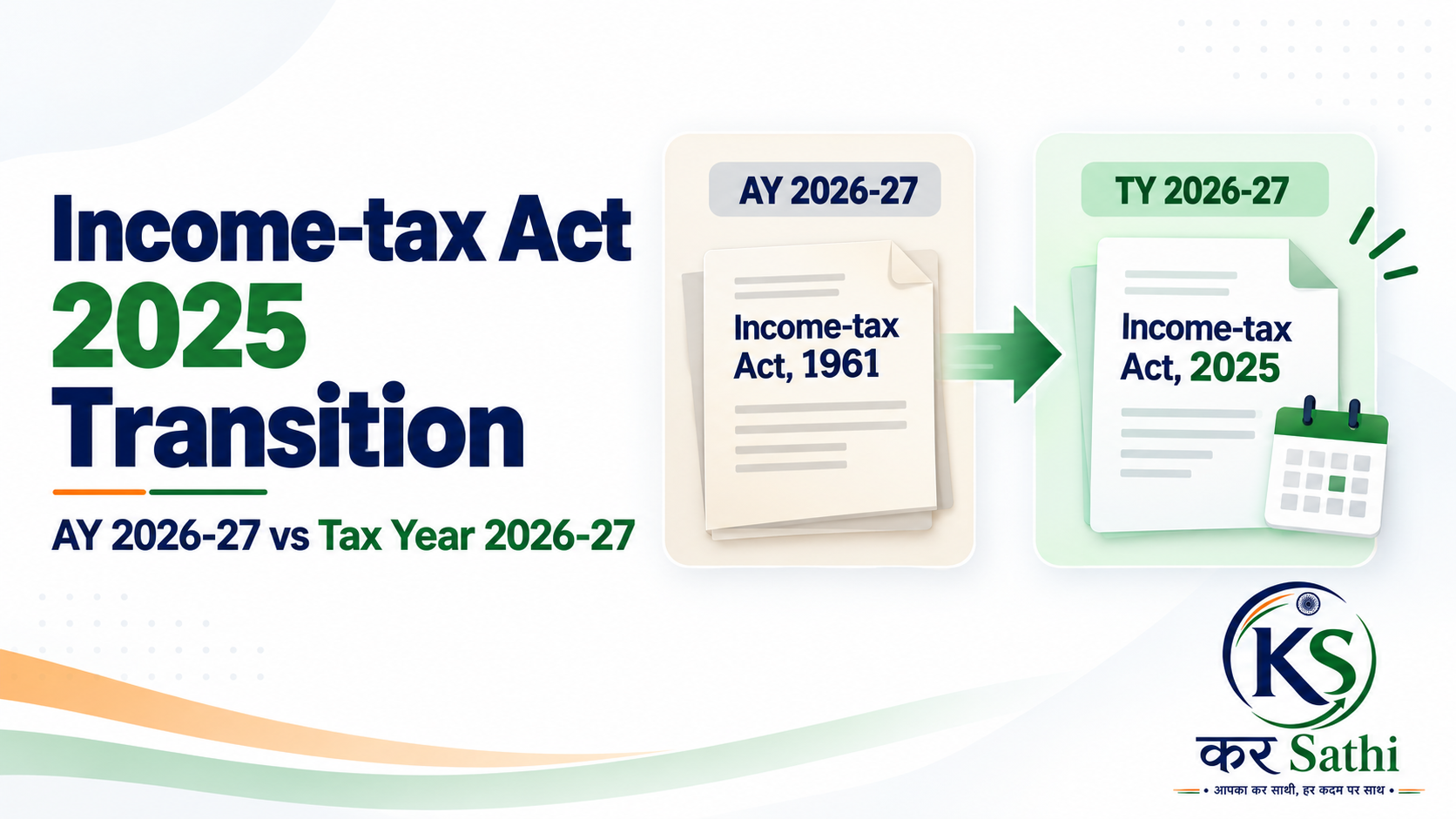
AY 2026-27 and TY 2026-27 Are Not the Same
The similar year labels can create confusion, but they relate to different income periods.
Assessment Year 2026-27
AY 2026-27 relates to income earned during FY 2025-26, from 1 April 2025 to 31 March 2026.
Because the income period began before the new Act came into force, it continues to be governed by the Income-tax Act, 1961.
Therefore
Use the ITR forms prescribed under the old Act;
Select AY 2026-27 on the e-Filing portal;
Use old section references;
Apply the old return, audit and correction framework; and
Continue using AIS and the relevant old-period tax statements.
This remains true even though the return is filed after 1 April 2026.
Tax Year 2026-27
TY 2026-27 covers income earned from 1 April 2026 to 31 March 2027.
It is governed by the Income-tax Act, 2025. During this period, taxpayers and businesses must use the new provisions for matters such as:
Salary and non-salary TDS;
Advance-tax payments;
Investment declarations;
Tax-audit preparation;
New-Act forms and section numbers; and
Reporting through Form 168.
The return for TY 2026-27 becomes due only after the Tax Year ends.
Will Taxpayers Have to File Two Returns?
No. The transition does not create a requirement to file two income tax returns for the same income period.
During 2026, a taxpayer may be
Filing an ITR for AY 2026-27 under the old Act; and
Paying advance tax or receiving salary subject to TDS for TY 2026-27 under the new Act.
These are separate compliances for separate income periods, not two returns for the same year.
Which Act Applies to Pending Matters?
The old Act continues to govern tax years that began before 1 April 2026.
This means that assessments, appeals, notices, reassessments, refunds, rectifications and other proceedings relating to AY 2026-27 or earlier years will generally continue under the Income-tax Act, 1961.
For example, if a taxpayer receives a notice in 2026 relating to AY 2024-25, the matter does not shift to the new Act merely because the notice or response falls after 1 April 2026.
Similarly, an updated return or correction relating to an earlier Assessment Year must be completed through the applicable old-Act framework.
How the e-Filing Portal Handles Both Acts
The Income Tax e-Filing portal supports compliance under both laws.
Forms are organised under different categories
Forms as per Income-tax Act, 2025
Forms as per Income-tax Act, 1961
Forms as per Other Acts
Before selecting a form, taxpayers should confirm
Whether the compliance relates to an Assessment Year or Tax Year;
The period in which the income, payment or transaction arose;
Whether the form belongs to the old or new Act; and
Whether a new form number has replaced an earlier form.
Selecting the wrong AY, TY or Act can cause tax-credit mismatches, defective filings or incorrect reporting.
Important Form and Section Changes
Salary TDS
For salary up to FY 2025-26, the relevant provision is Section 192 of the Income-tax Act, 1961.
For salary paid from April 2026 for TY 2026-27, the corresponding provision is Section 392(1) of the Income-tax Act, 2025.
Employers should reset salary-TDS calculations from 1 April 2026 using projected income, the selected tax regime and eligible deductions for TY 2026-27.
Section 80C Savings
For AY 2026-27, eligible deductions continue to be claimed with reference to Section 80C read with Section 80CCE of the old Act.
For TY 2026-27, the corresponding provision is Section 123 read with Schedule XV of the new Act.
The new numbering does not automatically make the deduction available under every tax regime. Eligibility must still be checked under the applicable regime and conditions.
Tax Audit
For FY 2025-26 and AY 2026-27, tax-audit reports continue through Forms 3CA, 3CB and 3CD under the old Act.
For TY 2026-27, the Income-tax Rules, 2026 prescribe common Form 26, which consolidates the earlier tax-audit forms.
Forms 15G and 15H
Under the old Act, Forms 15G and 15H were connected with Section 197A.
For a Tax Year beginning on or after 1 April 2026, the corresponding provision is Section 393(6), and the declaration is prescribed through Form 121.
AIS and Form 168
Taxpayers will have separate annual information statements for the two periods.
AY 2026-27
The existing AIS will contain TDS, TCS and other financial information relating to FY 2025-26 under the old Act.
TY 2026-27
Form 168 will serve as the annual information or annual tax statement for FY 2026-27 under the new Act.
Both statements will remain accessible through the e-Filing portal.
Taxpayers should reconcile their salary, interest, capital gains, TDS, TCS and other reported transactions with the correct statement before filing.
TDS during the Transition
For TDS, the applicable law generally depends on when the earlier of credit or payment occurs.
Example 1: Professional Fee Credited in March
A business credits professional fees in its books on 31 March 2026 but pays the amount in April 2026.
Because the credit occurred first and was on or before 31 March 2026, the TDS obligation falls under the old Act.
Example 2: April Service Payment
A contractor’s invoice is credited and paid in April 2026.
Because the relevant event occurs after the commencement of the new Act, the applicable TDS provision will be determined under the Income-tax Act, 2025.
Businesses should update accounting, payroll and TDS software with the new section numbers and form mappings.
Common Transition Mistakes
Taxpayers and businesses should avoid
Treating AY 2026-27 and TY 2026-27 as the same period;
Filing the AY 2026-27 return under the new Act;
Using new section numbers for old-period transactions;
Using old section numbers in TY 2026-27 payroll or TDS records;
Selecting the wrong Act on the e-Filing portal;
Comparing old-period AIS with new-period transactions;
Ignoring Form 168 for TY 2026-27;
Using new forms to correct an old-period filing; and
Assuming that pending notices automatically move to the new Act.
Practical Checklist
Before completing any tax compliance after 1 April 2026
Identify the income or transaction period.
Confirm whether it belongs to an Assessment Year or Tax Year.
Select the correct Act on the e-Filing portal.
Check whether the relevant form number has changed.
Use the correct section reference.
Reconcile TDS with the appropriate AIS or Form 168.
Keep old-period and new-period working papers separately.
Verify updated payroll and accounting software mappings.
Preserve acknowledgements and supporting documents.
Seek professional review where transactions cross 31 March and 1 April 2026.
Conclusion
The Income-tax Act, 2025 changes the structure, terminology, section numbers and forms used for tax compliance, but it does not transfer old-period obligations into the new law.
The simplest rule is
Income and transactions up to 31 March 2026 generally remain under the Income-tax Act, 1961.
Income and transactions from 1 April 2026 generally fall under the Income-tax Act, 2025.
AY 2026-27 and TY 2026-27 must be treated as separate periods.
Kar Sathi can help individuals, employers and businesses identify the correct Act, form, section and reporting period before filing. Proper classification at the beginning can prevent TDS mismatches, incorrect forms and avoidable compliance notices.
COMMON QUESTIONS
Answers before you file.
The Income-tax Act, 2025 came into effect on 1 April 2026, replacing the Income-tax Act, 1961. However, this does not mean that every return, notice, correction or tax proceeding after 1 April 2026 automatically falls under the new Act..
From April 2026, taxpayers handling certain property, rent, professional-payment or virtual-asset transactions no longer need to search for four different challan-cum-statements..
Receiving an income-tax assessment order can be stressful, especially when it is followed by possible penalty or prosecution proceedings. In eligible cases, however, a taxpayer may