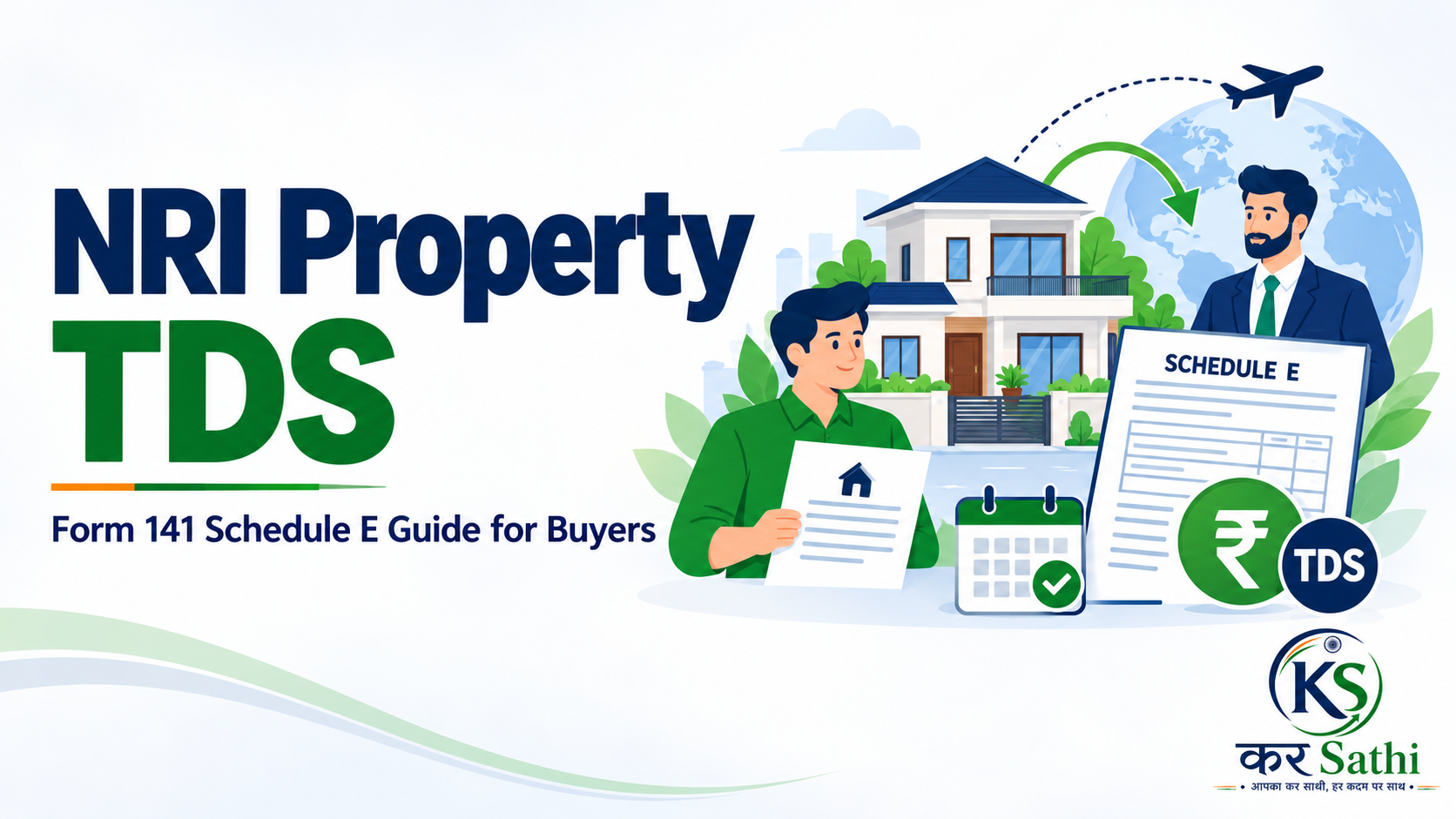
NRI Property TDS: Form 141 Schedule E Guide for Buyers
Buying property from an NRI involves a different TDS process from buying it from a resident seller. Treating both transactions alike can result in short deduction, interest, late.
Published 1 October 2026Last Updated 30 October 20267 min readBy Kar Sathi Team
Buying property from an NRI involves a different TDS process from buying it from a resident seller. Treating both transactions alike can result in short deduction, interest, late fees and a demand against the buyer.
From 1 October 2026, an eligible resident Individual or HUF buyer can report this transaction through Schedule E of Form 141 using a PAN login—without obtaining TAN solely for this transaction.
Schedule E at a Glance
Particular
WHY CLIENTS CHOOSE KAR SATHI
✓ Tax Experts✓ Maximum Refund Assistance✓ Notice Support✓ Secure Documents✓ Transparent Pricing✓ Fast Turnaround
Kar Sathi is an independent private platform and is not affiliated with, endorsed by, sponsored by, or authorized by any government entity. Government-related information provided by Kar Sathi is for informational purposes only. Users should verify information with the relevant official government source.
Purchase of immovable property from a non-resident seller
Form and schedule
Form 141—Schedule E
Effective date
1 October 2026
Eligible buyer
Resident Individual or resident HUF
Filing login
Buyer’s PAN login
TAN requirement
Not mandatory for an eligible Schedule E transaction from 1 October 2026
Payment and filing deadline
Within 30 days from the end of the month of deduction
Correction facility
TDS-TRACES portal
TDS rate
Transaction-specific; no single Form 141 rate
What Is Form 141 Schedule E?
Schedule E is the part of Form 141 used by a resident Individual or resident HUF purchasing immovable property from a non-resident seller and deducting tax under Section 393(2) of the Income-tax Act, 2025.
Before 1 October 2026, such a buyer generally had to obtain TAN and submit the prescribed TAN-based statement. From 1 October 2026, an eligible buyer can report and pay the TDS through Form 141 Schedule E using PAN-based access.
This is a procedural simplification. It does not mean that the buyer can apply the resident-seller property TDS rate.
Schedule B or Schedule E?
The seller’s residential status decides the relevant property schedule.
Seller’s status
Applicable Form 141 schedule
Resident seller
Schedule B
Non-resident seller
Schedule E, subject to buyer eligibility
Citizenship and residential status are not always the same. The buyer should obtain a clear declaration and appropriate supporting information about the seller’s tax-residential status before releasing the payment.
Where a property has both resident and non-resident sellers, they cannot be combined in the same schedule. The resident seller is reported through Schedule B and the non-resident seller through Schedule E, as applicable.
Who Can Use Schedule E?
Schedule E can be filed only where the purchaser or deductor is
A resident Individual; or
A resident Hindu Undivided Family.
Other buyer categories must use the applicable TAN-based TDS statement and process.
The Schedule E facility is available only for qualifying payment or credit dates from 1 October 2026 onward. The portal restricts the selectable Schedule E dates accordingly.
Is TDS Always 1% on an NRI Property Purchase?
No.
The commonly discussed resident-property rate should not automatically be applied when the seller is a non-resident.
The applicable TDS rate may depend on
Nature and period of the capital gain
Tax regime selected by the seller, where applicable
Seller’s PAN status
Applicable surcharge and health and education cess
Higher-rate provisions
A valid lower or nil-deduction certificate
Other relevant provisions applicable to the transaction
Form 141 itself does not prescribe one universal TDS rate. Schedule E requires the buyer to enter the applicable rate and the TDS amount, including surcharge and cess where applicable.
Because the buyer may become responsible for a short deduction, the rate should be determined before making or crediting the payment.
Lower-Deduction Certificate
Schedule E accommodates certificates issued under the applicable lower-deduction provisions.
If the seller has obtained a valid certificate, the buyer should verify
Certificate number
Seller’s PAN
Applicable transaction
Permitted rate or amount
Certificate validity
Remaining available limit
The buyer should not rely only on an email or informal calculation supplied by the seller.
Information Required for Schedule E
Before starting the filing, keep the following details ready
Buyer details
PAN and name
Residential status
Contact information
Percentage share in the property
Details of all co-buyers
Seller details
PAN, if available
Name and status
Non-resident status
Contact details
Overseas address
Percentage share in the property
Tax Identification Number, where applicable
Tax Residency Certificate, where relevant
Lower-deduction certificate details, if applicable
Property and transaction details
Property type
Complete address
Agreement date
Registration date, if available
Total stamp-duty value
Total sale consideration
Lump-sum or instalment payment
Current payment or credit amount
Earlier acknowledgement or reference number for subsequent instalments
Date of payment or credit
Date of TDS deduction
Applicable rate and TDS amount
The portal requires the full stamp-duty value and total consideration even where there are multiple parties. These figures should not be reduced merely because the logged-in buyer or a particular seller holds only a proportionate share.
Multiple Buyers, Sellers and Instalments
For multiple buyers, each deductor is generally responsible for filing Form 141 for their respective liable share.
A single deductor may include multiple sellers only where the portal conditions are met—for example, the sellers belong to the same corporate or non-corporate category and TDS is deducted in the same month.
For an instalment transaction
Select whether it is the first, subsequent or last instalment.
Enter the earlier acknowledgement or prescribed reference for subsequent instalments.
For the last instalment, report the total amount paid or credited, including the current instalment.
Review the TDS obligation before every instalment.
TDS compliance should not be postponed until registration or the final payment if an earlier payment or credit has already triggered deduction.
Schedule E Filing Process
Use the following portal path
Log in to the Income Tax e-Filing portal through the buyer’s PAN.
Select e-File.
Open e-Pay Tax.
Select Income Tax Act, 2025.
Choose New Payment.
Select Form 141.
Choose Schedule E.
Enter the buyer, seller, property and transaction information.
Enter the applicable TDS rate and amount.
Add interest or fee, if applicable.
Complete payment.
Save the acknowledgement and payment receipt.
Schedule E Due Date
Form 141 and the corresponding TDS payment must be completed within 30 days from the end of the month in which tax was deducted.
Example
If TDS is deducted on 12 November 2026, the Form 141 filing and payment should generally be completed by 31 December 2026.
Where deductions occur in different months, separate Form 141 filings are required for each month.
Correction and TDS Certificate
Schedule E corrections are not made through the Income Tax e-Filing portal. A filed Form 141 must be corrected through the TDS-TRACES portal after registering as a taxpayer.
After processing, the applicable TDS certificate can also be downloaded from TRACES and supplied to the NRI seller.
Preserve the following documents
Filed Form 141 acknowledgement
Tax-payment receipt
TDS certificate
Sale agreement and payment schedule
Seller’s residential-status declaration
PAN and overseas tax details
TDS-rate calculation
Lower-deduction certificate, if used
Common Mistakes Buyers Should Avoid
Applying the resident-seller rate automatically.
Selecting Schedule B instead of Schedule E.
Deciding residential status only from the seller’s passport.
Deducting TDS only at the time of property registration.
Ignoring surcharge, cess or higher-rate provisions.
Using an expired or mismatched lower-deduction certificate.
Proportionately reducing the total property value in fields requiring the complete value.
Combining resident and non-resident sellers in one schedule.
Missing the 30-day filing and payment deadline.
Failing to collect the acknowledgement and TDS certificate.
Final Takeaway
Schedule E removes the need for an eligible resident Individual or HUF buyer to obtain TAN solely for a qualifying NRI property transaction from 1 October 2026. However, the buyer remains responsible for determining the correct TDS rate, deducting the correct amount and filing on time.
Before paying an NRI seller, confirm the seller’s residential status, examine any lower-deduction certificate and calculate the applicable tax carefully.
Kar Sathi can assist with residential-status review, NRI property TDS calculation and Form 141 Schedule E filing.
COMMON QUESTIONS
Answers before you file.
Buying property from an NRI involves a different TDS process from buying it from a resident seller. Treating both transactions alike can result in short deduction, interest, late fees and a demand against the buyer. From 1 October 2026, an.
From April 2026, taxpayers handling certain property, rent, professional-payment or virtual-asset transactions no longer need to search for four different challan-cum-statements..
Receiving an income-tax assessment order can be stressful, especially when it is followed by possible penalty or prosecution proceedings. In eligible cases, however, a taxpayer may